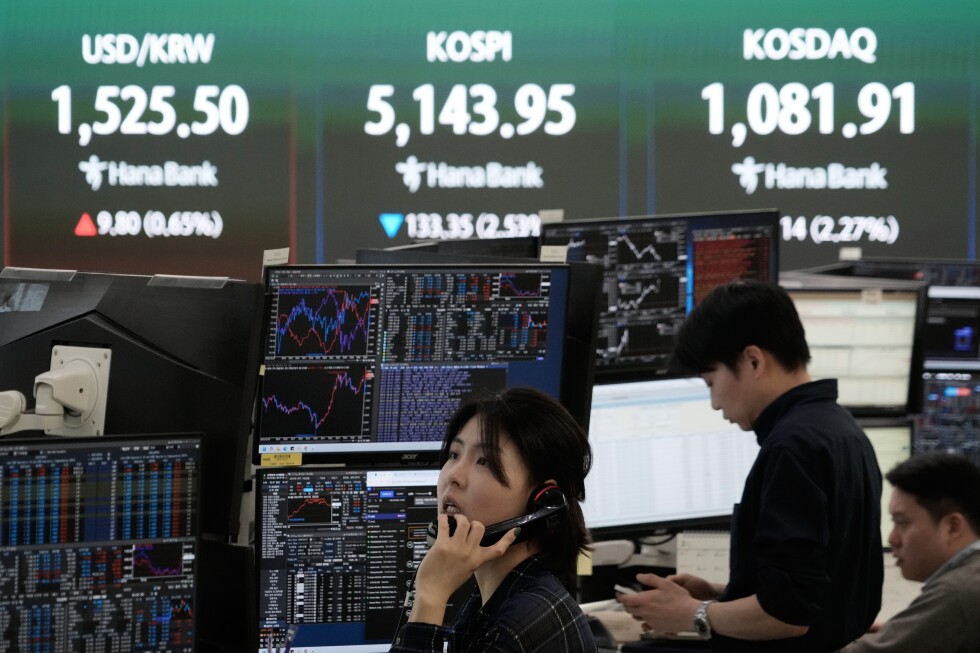
HONG KONG – As the Iran war enters its fifth turbulent week, global financial markets remain gripped by a volatile cocktail of geopolitical tensions and economic uncertainty. While oil prices have shown a surprising degree of stability, Asian stock markets experienced significant downturns on Tuesday, reflecting investor jitters over conflicting signals regarding a potential de-escalation of the protracted conflict.
Asian Markets Bear the Brunt of Uncertainty
The immediate impact of the prolonged conflict is starkly visible across Asia's financial hubs. Tokyo's Nikkei 225, a bellwether for regional economic sentiment, registered a notable decline of 1.2%, closing at 51,245.50. Further south, South Korea's Kospi suffered even heavier losses, shedding 3.4%. These movements underscore a deep-seated anxiety among investors who are struggling to price in the true cost and duration of the Iran war.
The prevailing sentiment is one of caution, with market participants opting for risk-off strategies. Geopolitical conflicts of this magnitude typically trigger capital flight from emerging markets and export-dependent economies, which are particularly susceptible to disruptions in global trade routes and energy supply chains. The lack of a clear end in sight to the Iran conflict means that this cautious stance is likely to persist, potentially dampening regional investment and consumption.
The Enigma of Steady Oil Prices
Paradoxically, despite a major conflict unfolding in a critical oil-producing region, crude oil prices have managed to steady themselves. This stability, though seemingly counterintuitive, can be attributed to several factors. Firstly, a significant portion of the geopolitical risk premium may have already been factored into prices during the initial weeks of the conflict. Traders might also be reacting to reports – however mixed – of potential de-escalation, preventing prices from spiraling further upwards.
Furthermore, global crude inventories, strategic reserves, and the collective capacity of other major oil producers to potentially offset any supply disruptions from the Middle East might be providing a buffer. However, this equilibrium is fragile. Any definitive shift towards escalation or significant disruption to shipping lanes through the Strait of Hormuz could rapidly shatter this fragile stability, sending oil prices soaring and triggering inflationary pressures worldwide.
Broader Economic and Geopolitical Implications
Beyond immediate market fluctuations, the protracted Iran war carries profound long-term implications for the global economy and geopolitical landscape. A prolonged conflict risks exacerbating global inflation, disrupting supply chains already reeling from recent shocks, and diverting critical resources towards defense spending rather than economic development.
For Asian economies, heavily reliant on imported energy and export markets, the uncertainty poses a double threat. Higher energy costs erode corporate profits and consumer purchasing power, while a slowdown in global trade demand impacts their export competitiveness. The geopolitical ripple effects also extend to regional alliances and security architectures, potentially reshaping diplomatic relations and increasing instability in an already complex part of the world.
The Path Forward: Awaiting Clarity
As the fifth week of the Iran war concludes, the global economy finds itself at a precarious juncture. The mixed signals surrounding de-escalation efforts highlight the fluidity of the situation and the difficulty in predicting its trajectory. Investors, policymakers, and citizens alike are left to navigate a landscape defined by uncertainty, with the hope that diplomatic breakthroughs can avert further economic damage and human cost. The world watches keenly, understanding that the resolution, or lack thereof, of this conflict will resonate far beyond the battlefields of Iran.