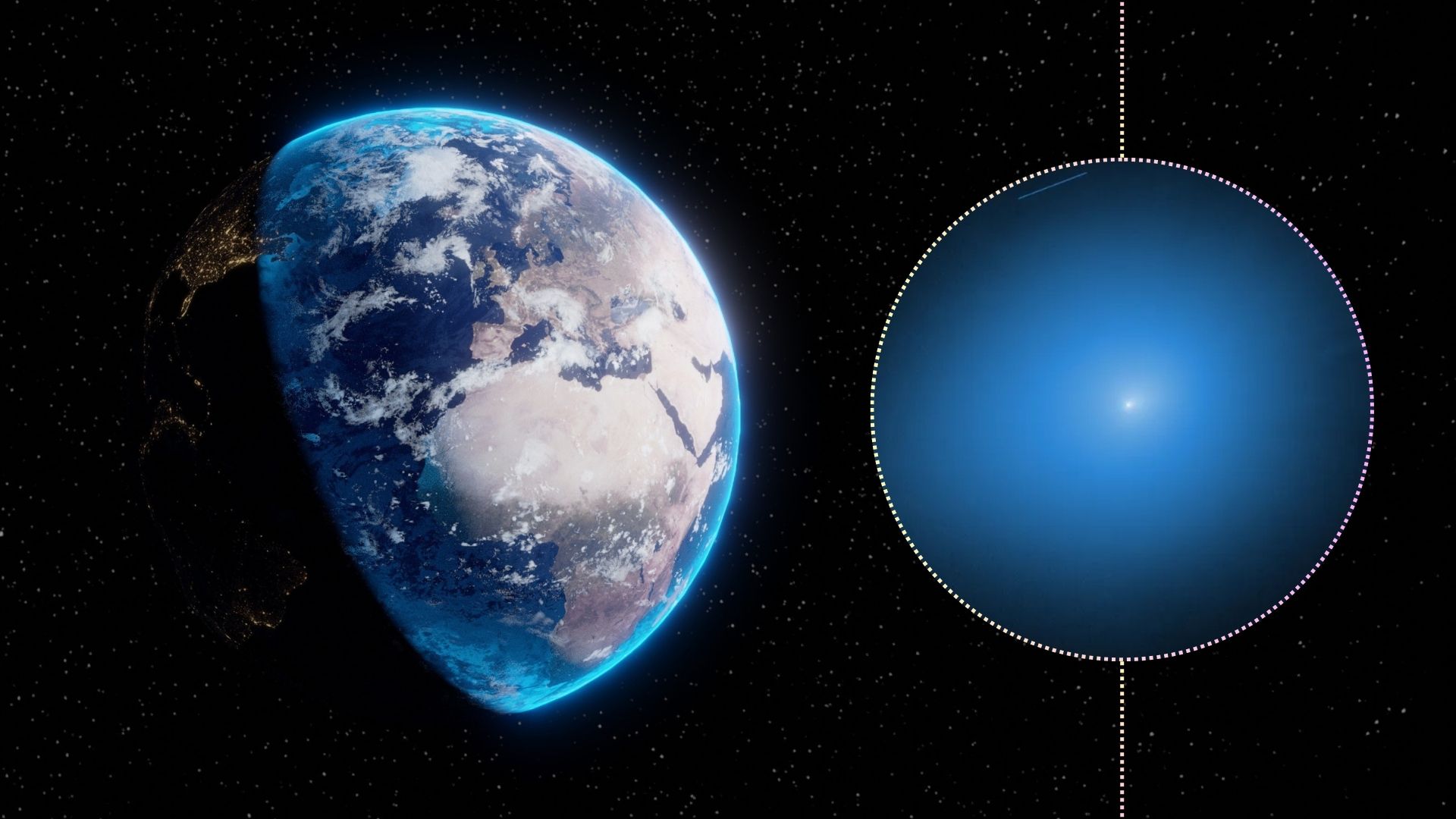
3I/ATLAS: Unveiling the Secrets of an Interstellar Wanderer as It Brushes Past Earth
On December 19, humanity gets a rare, fleeting glimpse into another star system's past, courtesy of a remarkable celestial visitor.
The universe is vast and full of wonders, but few events captivate the scientific community and the public imagination quite like the arrival of a true interstellar visitor. On Friday, December 19, an object known as interstellar comet 3I/ATLAS will make its closest approach to Earth. This isn't just another comet; it's a cosmic messenger from beyond our solar system, offering an unparalleled opportunity to study material forged in the crucible of another star's birth.
A Glimpse Beyond Our Cosmic Neighborhood
For decades, scientists theorized the existence of objects traveling between star systems, ejected from their home stellar nurseries by gravitational slingshots. It wasn't until 2017, with the discovery of 'Oumuamua, followed by interstellar comet 2I/Borisov in 2019, that these theories were definitively confirmed. 3I/ATLAS is only the third such object ever observed, making its December 19 close approach a truly momentous occasion.
Unlike comets native to our own Kuiper Belt or Oort Cloud, 3I/ATLAS's trajectory clearly indicates an origin from interstellar space. It's moving too fast to be gravitationally bound to our Sun, soaring through our system on a hyperbolic path – a one-way trip through our stellar neighborhood before it continues its solitary journey back into the depths of the Milky Way. Its brief visit provides a unique window into the chemical and physical conditions of a distant planetary system, long before its discovery by human eyes.
Why December 19 Matters for Science
The closest approach on December 19 is not merely a date on a calendar; it's a critical observational window. While the comet will pass safely by Earth, its proximity significantly enhances our ability to study it in unprecedented detail. Astronomers worldwide are gearing up, deploying an array of instruments to extract as much information as possible from this fleeting encounter.
What exactly are they looking for? Primarily, its composition. By analyzing the light reflected and emitted by 3I/ATLAS – a technique known as spectroscopy – scientists can determine the elements and molecules present in its coma and nucleus. This includes volatile compounds like water, carbon monoxide, and various organic molecules, which are the building blocks of planets. Comparing these to comets born in our own solar system can reveal stark differences or surprising similarities, painting a picture of chemical diversity (or universality) across the galaxy.
Imaging efforts will also be crucial. High-resolution telescopes will attempt to resolve details of its nucleus, estimate its size, shape, and rotation rate, and observe any signs of outgassing or fragmentation. Understanding its physical properties offers clues about the violent processes that might have ejected it from its home system.
Implications for Planetary Formation and Astrobiology
The data gathered from 3I/ATLAS has profound implications, extending far beyond simply cataloging another celestial object. Each interstellar comet serves as a time capsule, preserving primordial material from its birth environment. By studying 3I/ATLAS, we are essentially getting a direct sample – albeit observed remotely – of the raw ingredients that went into forming planets around another star.
- Exoplanetary Chemistry: What are the dominant volatile compounds in other protoplanetary disks? Are they similar to our own, suggesting common formation pathways, or vastly different, indicating unique chemical evolutionary paths?
- The Origin of Life: Comets are known to carry complex organic molecules. Could these interstellar travelers be vehicles for distributing such pre-biotic compounds throughout the galaxy? Studying 3I/ATLAS could shed light on the ubiquity of these ingredients and their potential role in abiogenesis on other worlds.
- Solar System Evolution: Understanding objects that leave other systems helps us understand the dynamics that shaped our own. When did our solar system eject its own cometary wanderers, and what were they like?
The Future of Interstellar Archaeology
The increasing frequency of interstellar object detections – three in just six years – suggests that these wanderers might be more common than previously thought. Upcoming observatories like the Vera C. Rubin Observatory, with its vast sky-surveying capabilities, are expected to dramatically increase the rate of discovery. This means that 3I/ATLAS is not just a fascinating anomaly, but a harbinger of a new era in astronomy – one where we regularly probe the compositions and origins of objects born under different stars.
While we won't be sending a probe to 3I/ATLAS this time, each close pass of an interstellar object brings us closer to a future where such missions might be considered. Imagine a spacecraft intercepting an object from another star, bringing back samples for direct laboratory analysis. This ambitious goal remains distant, but the groundwork is being laid with every observation of a visitor like 3I/ATLAS.
Conclusion: A Cosmic Postcard
As 3I/ATLAS makes its closest approach and then fades back into the interstellar void, it leaves behind more than just a trail of dust and gas. It leaves behind a wealth of data and a deepened understanding of our place in the cosmos. It's a cosmic postcard from a distant, unknown star system, reminding us of the infinite possibilities and untold stories waiting to be discovered across the galaxy. December 19 isn't just a day for observation; it's a day for cosmic reflection.