Mars's Accelerating Spin: Unraveling the Mystery of the Subterranean Anomaly
The Red Planet, long a subject of human fascination and scientific inquiry, continues to surprise us. Recent data from NASA's landers have unveiled a startling truth: Mars is spinning faster, causing its days to subtly shorten. This isn't just a quirky planetary fact; it points to profound geological activity deep within Mars, driven by what scientists are calling a "substantial negative mass anomaly" located 1,200 kilometers below the planet's surface in the notorious Tharsis region.
The Unsettling Discovery: A Planet Picking Up Pace
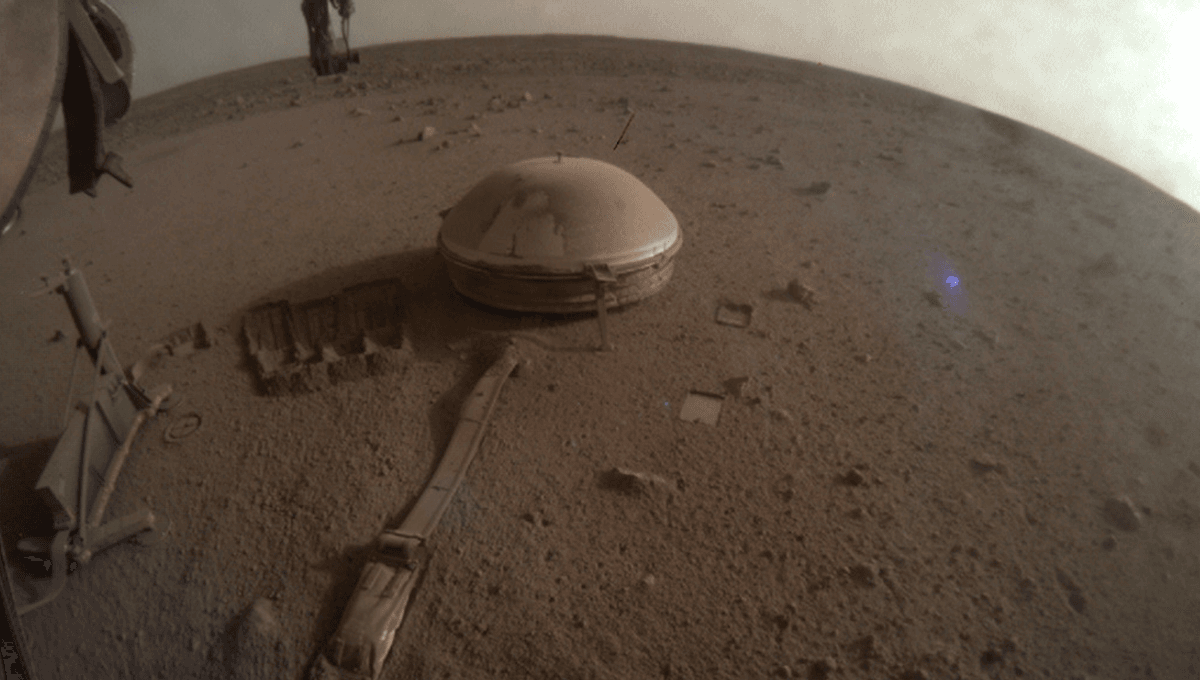
For years, Earth-based observations and orbital missions have provided increasingly precise measurements of Mars's rotational dynamics. However, it was the deployment of advanced seismometers, particularly NASA's InSight lander, that provided the granular data needed to detect minute changes in the planet's spin. The findings are unequivocal: Mars is indeed accelerating, with its rotational speed increasing by roughly 4 milliarcseconds per year – a subtle yet significant shift on a planetary scale.
What is a 'Negative Mass Anomaly'?
The term "negative mass anomaly" might conjure images of exotic matter, but in planetary science, it refers to a region within a celestial body that exhibits a significantly lower gravitational pull than its surroundings. This is typically due to a localized area of lower density material. Imagine a vast, subterranean bubble or a region where the mantle material is less compact than average. In the case of Mars, this anomaly is hypothesized to be a massive area of less dense rock or perhaps a region with a higher concentration of volatiles, situated far beneath the planet's crust.
Tharsis: A Region of Immense Geological Significance
The anomaly's location – 1,200 kilometers deep beneath the Tharsis region – is particularly intriguing. Tharsis is an immense volcanic plateau on Mars, home to some of the largest volcanoes in the solar system, including Olympus Mons. This region is a colossal bulge, stretching thousands of kilometers across and rising several kilometers high, fundamentally altering Mars's overall shape and gravitational field. The sheer mass of Tharsis has long been known to influence Mars's rotation and orientation. The discovery of a deep, low-density region within its foundations suggests a complex interplay of forces. It implies that the massive volcanic outpourings that built Tharsis might have originated from, or been influenced by, an underlying mantle structure that is far from uniform.
The Mechanics of Acceleration: Conservation of Angular Momentum
How does a deep-seated, less dense region cause a planet to spin faster? The principle at play is the conservation of angular momentum. Similar to how an ice skater speeds up her spin by pulling her arms inward, a planet's rotational speed can increase if its mass is redistributed closer to its axis of rotation, or if its effective moment of inertia decreases. While the precise mechanism related to this deep anomaly is still under investigation, one hypothesis suggests that the low-density region is causing a slight shift in the planet's mass distribution, or perhaps interacting with the mantle convection in a way that subtly reduces the planet's moment of inertia over geological timescales. This could be due to ongoing internal processes, like mantle plumes or convection cells, slowly shifting material or changing the planet's internal structure.
Implications for Planetary Evolution and Future Missions
This discovery is more than just a cosmic curiosity; it offers profound insights into the interior dynamics and evolutionary history of Mars. Understanding the nature and evolution of this negative mass anomaly can help scientists:
- Refine Models of Planetary Formation: It provides critical data for models attempting to explain how rocky planets form and differentiate their interiors over billions of years.
- Map Mars's Interior Structure: Coupled with seismic data, gravity measurements offer a clearer picture of Mars's layered interior, from its crust to its core.
- Understand Volcanic History: The anomaly's proximity to Tharsis suggests a deep connection to the region's immense volcanic past and potential future.
- Enhance Future Mission Planning: Precise knowledge of Mars's rotational dynamics is crucial for everything from landing precision for future missions to optimizing orbital mechanics for satellites.
The Path Forward: More Data, Deeper Understanding
The current findings are based on a meticulous analysis of existing data, primarily from the InSight mission. However, further studies will be required to fully characterize this subterranean enigma. Future missions equipped with more advanced seismometers and gravity mapping instruments could provide even greater resolution, potentially revealing the exact composition and nature of this anomaly. The Red Planet continues to be a dynamic world, full of secrets waiting to be uncovered, reminding us that even in our own cosmic backyard, the universe never ceases to amaze.