Did an Interstellar Visitor Spark Earth's Recent Meteor Fireball Surge? Unpacking the 3I/ATLAS Hypothesis
A surge in dazzling meteor fireballs streaking across our night skies has ignited fervent discussions among astronomers and space enthusiasts alike. Is this a mere coincidence, or are we witnessing the cosmic aftermath of an extraordinary encounter? According to prominent Harvard astrophysicist Avi Loeb, the answer might lie in the recent, fleeting visit of an enigmatic interstellar object: 3I/ATLAS.
The Interstellar Intruder: A Close Call with 3I/ATLAS
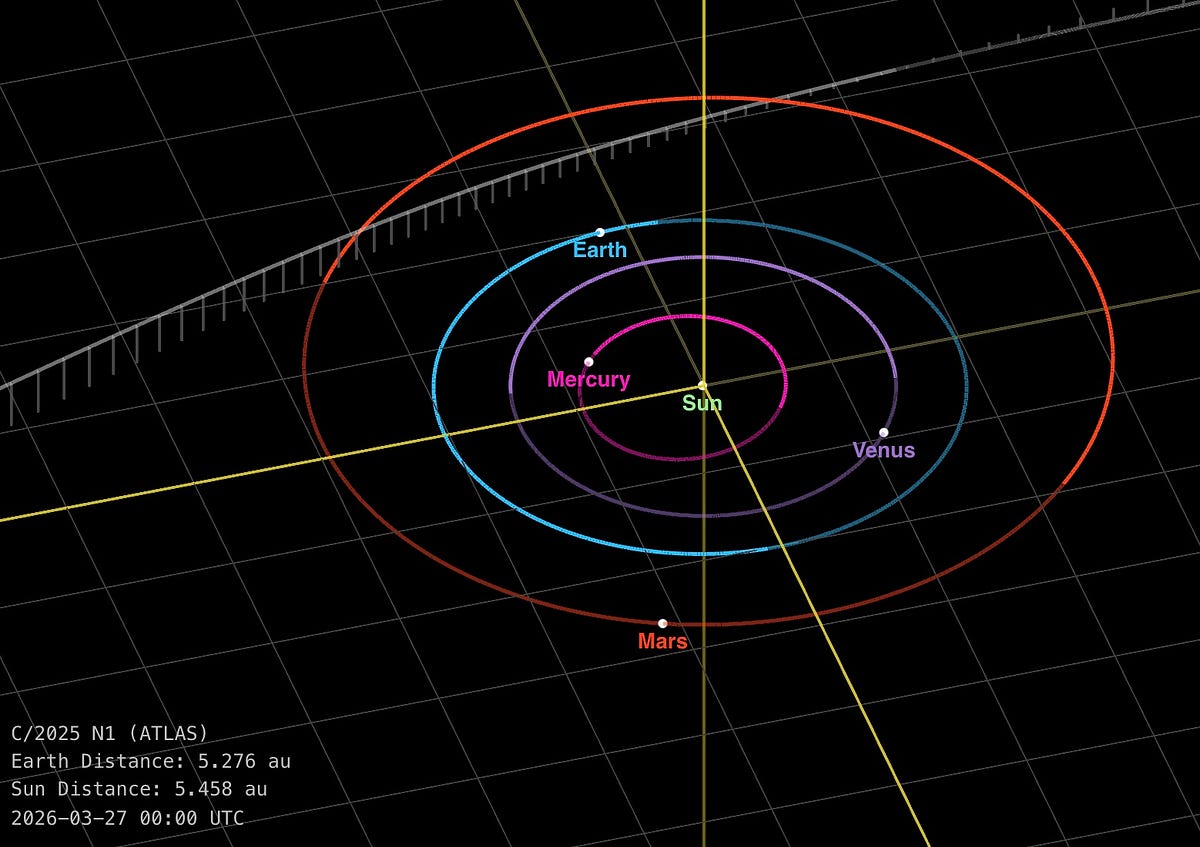
In the grand cosmic ballet, our planet Earth occasionally crosses paths with celestial wanderers. Most are familiar comets and asteroids from our own solar system. However, 3I/ATLAS is different. Discovered as an interstellar comet, it represents a truly alien visitor, originating from beyond our Sun's gravitational influence. Its trajectory carried it through our solar neighborhood, and crucially, in the second half of March 2026, Earth arrived within a remarkably close 54.6 million kilometers of its orbital path.
This close proximity, while still a vast distance by human standards, is significant in astronomical terms. The very notion that Earth could pass near the trail of an interstellar object opens up fascinating possibilities, particularly concerning any debris it might have shed during its journey.
Avi Loeb's Hypothesis: A Trail of Interstellar Dust
Professor Avi Loeb, known for his unconventional yet rigorously scientific approaches to cosmic phenomena, posits that the recent increase in observed meteor fireballs could be directly linked to 3I/ATLAS. His hypothesis centers on the idea that as 3I/ATLAS navigated our solar system, particularly when it was heated by the Sun, it may have shed significant amounts of dust, ice, and small rocky fragments. These particles, no longer gravitationally bound to the parent object, would then form a diffuse trail along its orbital path.
When Earth subsequently crossed through the vicinity of this trail, as it did in late March 2026, it would naturally encounter a higher density of these interstellar particles. Larger fragments, entering Earth's atmosphere at immense speeds, would manifest as the brilliant, incandescent fireballs we've been witnessing. This scenario paints a compelling picture: instead of encountering debris from familiar comets, we might be experiencing an unprecedented shower of material from another star system.
The Anatomy of a Fireball: Interstellar vs. Local
Meteor fireballs are essentially very bright meteors – cosmic rocks or dust particles burning up as they plunge through Earth's atmosphere. While Earth experiences countless meteors daily, a "fireball" denotes one brighter than Venus. The key question for Loeb's hypothesis is whether the recent surge in these luminous events, especially those exhibiting unusual characteristics, can be definitively traced to 3I/ATLAS.
Distinguishing interstellar debris from typical solar system material is a formidable challenge. Scientists often analyze the trajectory, speed, and even the composition of recovered meteorites. Interstellar objects typically exhibit extreme velocities and hyperbolic orbits, distinct from objects bound to our Sun. If observed fireballs show these tell-tale signs, it would lend strong support to Loeb's theory.
The Broader Implications and Future Research
If confirmed, the 3I/ATLAS hypothesis would represent a monumental shift in our understanding of interstellar objects and their potential impact on our planet. Firstly, it would provide a novel, albeit indirect, method for studying the composition and characteristics of material originating from other star systems, offering invaluable insights into exoplanetary formation and stellar evolution.
Secondly, it highlights the dynamic nature of our galactic neighborhood. The cosmos is not static; interstellar visitors are not just fleeting specters but potential sources of new material entering our environment. This underscores the importance of advanced observational networks, like specialized meteor cameras and infrasound arrays, capable of detecting and tracking these events with greater precision.
Further research will involve meticulously cross-referencing fireball observation data with Earth's orbital position relative to 3I/ATLAS's path. Scientists will also look for any peculiar orbital characteristics of the incoming meteoroids that might suggest an interstellar origin. While definitive proof remains elusive, the tantalizing possibility that we are literally touching fragments from another star system is a testament to the boundless mysteries that still await discovery.
Conclusion: A Glimpse Beyond Our Solar System
The proposed link between the recent meteor fireball surge and the interstellar object 3I/ATLAS is a captivating narrative at the forefront of astrophysics. It challenges us to look beyond our familiar cosmic backyard and consider the profound implications of galactic wanderers. Whether this hypothesis holds true or not, it undeniably fuels our curiosity about the universe and reinforces the thrilling pursuit of scientific discovery, reminding us that sometimes, the most extraordinary answers fall right out of the sky.