Lunar Lifeline: Earth's Atmospheric Leak and Its Profound Implications for Future Moon Bases
For billions of years, a silent, invisible bridge has connected Earth and its celestial companion, the Moon. New groundbreaking research reveals that our planet's very atmosphere has been steadily leaking, sending a constant stream of atoms and molecules across the vastness of space to settle on the lunar surface. This isn't just a fascinating cosmic quirk; it's a discovery that solves an enduring lunar mystery and carries profound implications for the next generation of astronauts aiming to make the Moon a second home.
Imagine finding a piece of your hometown thousands of miles away, utterly unexpectedly. That's essentially what Apollo astronauts did decades ago when they brought back lunar samples containing traces of noble gases and nitrogen that seemed suspiciously terrestrial in origin. For a long time, the mechanism behind this "lunar anomaly" remained elusive, a puzzle piece missing from our understanding of the Earth-Moon system. Now, scientists have pieced together the cosmic currents responsible, illuminating a process that has shaped the Moon's surface and potentially its future.
The Invisible Bridge: How Earth's Breath Reaches the Moon
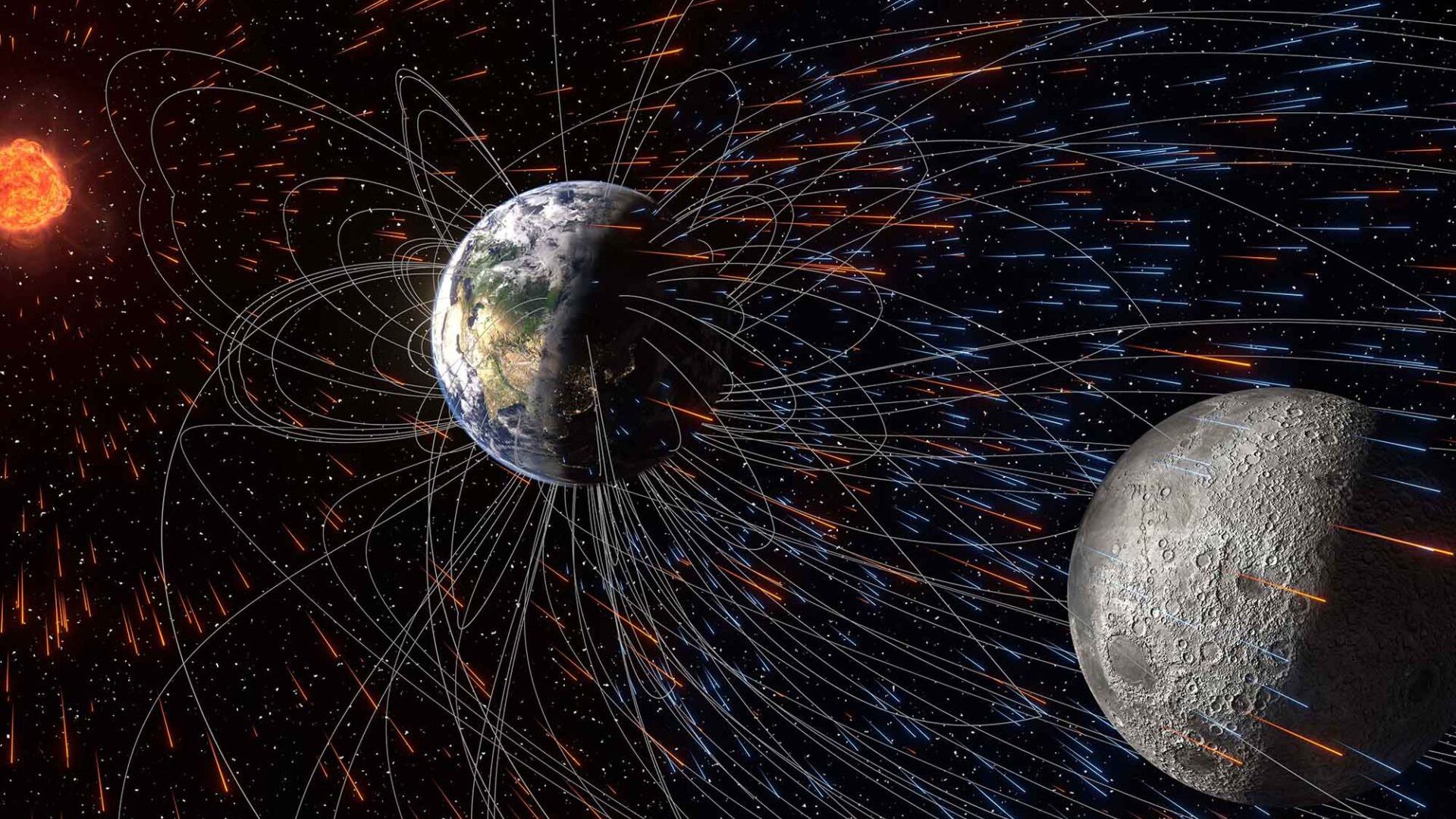
The primary culprit and benefactor in this cosmic exchange is Earth's magnificent magnetosphere. While often lauded as our planetary shield, deflecting harmful solar radiation, it also plays a crucial role in funneling atmospheric particles. Our upper atmosphere is a turbulent sea where atoms and molecules are constantly ionized and swept away by the solar wind. However, when the Moon passes through Earth's extended magnetotail – a stretched-out region of the magnetosphere extending far beyond the planet – these Earth-originated ions are redirected.
During these periods, which occur for roughly five days each month, the Moon is bathed in a plasma cloud rich with elements stripped from our home planet. These include critical elements like nitrogen, oxygen, argon, and helium. Rather than simply floating by, these energetic particles are implanted directly into the Moon's uppermost layer, the regolith, accumulating over countless millennia. This continuous bombardment explains the consistent presence of Earth-derived components found in lunar soil, validating the initial perplexing observations from the Apollo era.
Solving a Decades-Old Lunar Mystery
The detection of "terrestrial" nitrogen and noble gases in lunar samples brought back by Apollo missions was a significant enigma. The Moon lacks a substantial atmosphere to trap such gases, and the prevalent theory for their presence usually involved solar wind implantation. However, the isotopic signatures of some of these elements pointed squarely back to Earth. This new research provides a elegant and comprehensive explanation, demonstrating that our own planet has been a steady, albeit gentle, contributor to the Moon's surface chemistry throughout its geological history. It refines our understanding of lunar surface processes and the long-term interactions within the Earth-Moon system.
A Glimmer of Home: Implications for Future Lunar Habitats
Beyond the scientific intrigue, this discovery holds tangible implications for humanity's ambitious return to the Moon. As missions like Artemis plan for sustainable lunar outposts, the presence of Earth-derived volatiles, however sparse, offers intriguing possibilities for in-situ resource utilization (ISRU). While we won't be setting up air purifiers to breathe Earth's "leaked" atmosphere directly, the cumulative deposits of nitrogen, oxygen, and helium embedded in the regolith could, in theory, be extracted and processed. These elements are vital for life support systems, propellants, and even future manufacturing processes on the Moon.
Moreover, the very idea that a "little bit of home" awaits astronauts on the Moon carries a profound psychological weight. It underscores the deep, often unseen, connection between our worlds. The Moon is not merely a barren rock but a cosmic archive, subtly etched with the fingerprints of its parent planet. Understanding these continuous processes allows us to better predict the lunar environment, protect future infrastructure, and perhaps even leverage these resources in innovative ways to build a self-sustaining presence beyond Earth.
The Future of Lunar Exploration, Rewritten
This research fundamentally enriches our understanding of the Earth-Moon system's co-evolution. It demonstrates that celestial bodies are not isolated entities but are intricately linked through dynamic processes spanning eons. As we look towards building permanent human settlements on the Moon, knowing that Earth has been silently sending its essence across space for billions of years adds a new, comforting layer to our lunar aspirations. The Moon might be an alien world, but thanks to this cosmic umbilical cord, it's also a place where a piece of home has always been waiting.