The Cosmic Conundrum: Webb Telescope's Mysterious Red Dots Are Rewriting Astrophysics
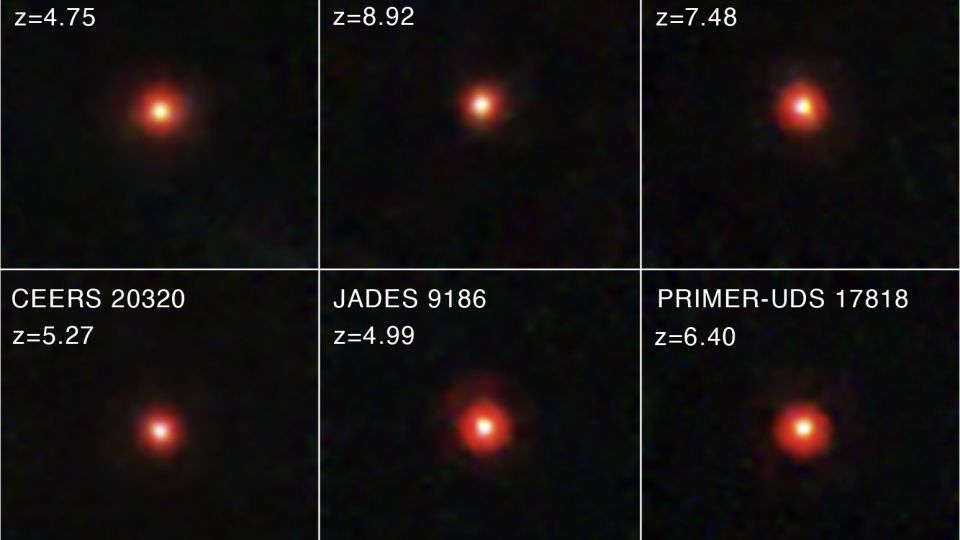
The James Webb Space Telescope (JWST), a marvel of modern engineering and our most powerful eye on the universe, has consistently delivered breathtaking images and unprecedented insights into the cosmos. Yet, amidst the glittering nebulae and distant galaxies, a puzzling phenomenon has emerged, challenging astronomers and potentially reshaping our understanding of the early universe: hundreds of tiny, bright "little red dots."
Unveiling the Unexpected: What Are These Dots?
These cosmic anomalies, appearing in nearly every deep-field snapshot captured by Webb, are not mere artifacts or background noise. They are distinct, vibrant red points of light, often seemingly isolated, and their sheer ubiquity is what has truly baffled the scientific community. Initial observations suggest they are extraordinarily compact and incredibly luminous, given their apparent size. Their "redness" indicates extreme redshift, meaning they are incredibly distant, observed as they were billions of years ago, shortly after the Big Bang.
The Webb telescope, optimized for infrared vision, excels at peering through cosmic dust and stretching light from the earliest epochs of the universe. It was designed to detect the faint signatures of the first galaxies, the "cosmic dawn" that followed the universe's dark ages. While Webb has delivered on this promise, the little red dots present an unforeseen twist. They don't neatly fit into existing categories of known celestial objects for that era.
Challenging Established Cosmological Models
Current cosmological models, particularly those describing galaxy formation, suggest a gradual assembly of structures. Smaller galaxies merge to form larger ones over billions of years. The presence of numerous, potentially massive, compact objects so early in the universe's history — perhaps just a few hundred million years after the Big Bang — throws a significant wrench into this well-established narrative. If these red dots represent ultra-early, massive galaxies or quasars, they formed much faster and grew far larger than theories predict.
Astronomers are grappling with several leading hypotheses, each with profound implications:
- Early, Massive Galaxies: If these are very early galaxies, they must have condensed and accumulated mass at an astonishing rate, requiring a re-evaluation of the initial conditions of the universe or the mechanisms driving early star formation.
- "Naked" Supermassive Black Holes: Another intriguing possibility is that these are very early, accreting supermassive black holes, perhaps without the host galaxy that astronomers typically expect to surround them. Such "seed" black holes, growing rapidly, could explain their intense luminosity and compact appearance.
- A New Class of Object: Perhaps most excitingly, the red dots could represent an entirely new, undiscovered class of astronomical object, a cosmic entity for which we currently have no theoretical framework. This would necessitate a fundamental shift in our understanding of physics in the early universe.
The Quest for Answers: What's Next?
The discovery of these enigmatic objects underscores the primary mission of the Webb telescope: to push the boundaries of our knowledge and challenge our preconceptions about the cosmos. Researchers are now actively engaged in follow-up observations, attempting to obtain spectroscopic data from these red dots. Spectroscopy, the analysis of light's spectrum, can reveal crucial information about an object's composition, temperature, velocity, and distance with far greater precision.
Such detailed analysis will be critical in distinguishing between the various hypotheses. Are they rich in heavy elements, indicating multiple generations of stars, or composed primarily of primordial hydrogen and helium? Do their spectral lines show evidence of active galactic nuclei, pointing to powerful black holes?
A Universe Full of Surprises
The "little red dots" are a powerful reminder that despite centuries of astronomical inquiry, the universe still holds countless secrets. They are a testament to the fact that with every leap in observational technology, our cosmic narrative gets richer, more complex, and often, more mysterious. Whatever these enigmatic points of light turn out to be, their existence has already ignited new avenues of research and promises to deepen our understanding of how our universe came to be. The cosmos, it seems, is far stranger and more wonderful than we've ever imagined.