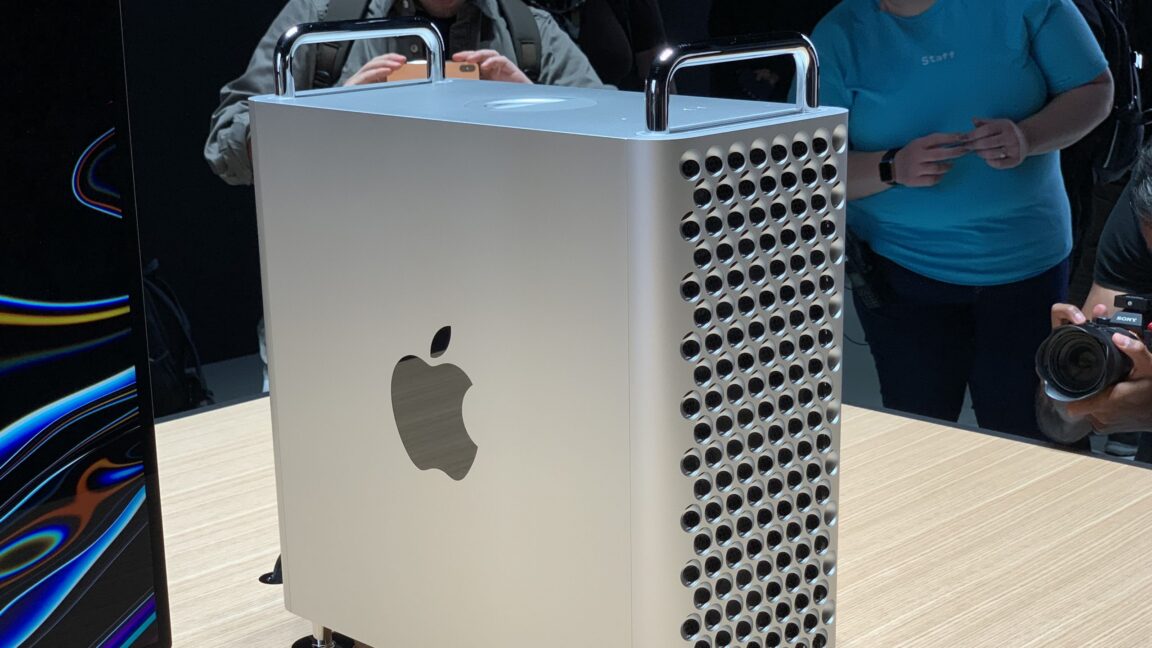
The news arrived not with a bang, but with a quiet update to Apple's online store: the M2 Ultra Mac Pro is no longer for sale. What might seem like a routine product cycle update is, in fact, a seismic shift in Apple's strategy for its professional users. After years of what Ars Technica aptly called "fitful effort," Apple has finally pulled the plug on its most powerful and traditionally most expandable desktop, stating unequivocally that no replacement is planned. This isn't just the end of a product; it marks a significant pivot in how Apple defines and delivers professional-grade hardware.
A Legacy of Power and Performance: The Mac Pro's Storied Past
For decades, the Mac Pro has been synonymous with Apple's commitment to the most demanding creative professionals. From its roots as the Power Mac G5 to the iconic "cheese grater" tower, the Mac Pro was the machine for high-end video editing, 3D rendering, scientific computing, and specialized audio production. It offered unparalleled internal expansion, allowing users to customize their machines with multiple GPUs, vast amounts of RAM, and various PCIe cards crucial for specific workflows.
The line wasn't without its controversies. The 2013 "trash can" Mac Pro, while visually striking and powerful for its time, frustrated many with its limited internal expandability. Apple acknowledged this misstep, promising a return to modularity, which eventually materialized in the 2019 Mac Pro – a true beast of a machine that, ironically, felt like a callback to its pre-2013 glory days, albeit with a premium price tag that put it out of reach for many.
The Apple Silicon Revolution: Redefining "Pro" Computing
The ultimate demise of the Mac Pro can be traced directly to Apple's most significant architectural shift in recent memory: the transition to Apple Silicon. Chips like the M1, M2, and now M3 families have fundamentally changed the performance landscape. The integrated system-on-a-chip (SoC) design, combining CPU, GPU, Neural Engine, and unified memory on a single die, delivers astonishing performance-per-watt and often outperforms traditional discrete component architectures in many professional tasks.
The introduction of the Mac Studio, particularly with its M1 Ultra and M2 Ultra configurations, was the first nail in the Mac Pro's coffin. Offering performance levels that rivaled, and in many cases surpassed, the Intel-based Mac Pro, but in a significantly smaller, more power-efficient, and less expensive package, the Mac Studio quickly became the new darling of professional users. Its I/O, including multiple Thunderbolt ports, made external expansion viable for many, further eroding the Mac Pro's unique selling proposition of internal PCIe slots.
Market Realities and Apple's Vision
The decision to discontinue the Mac Pro without a successor reflects several realities. Firstly, the market for extreme, internally expandable tower workstations is increasingly niche. Many professional workflows have adapted to powerful laptops, smaller desktops like the Mac Studio, or cloud-based solutions. Secondly, Apple's design philosophy under Apple Silicon prioritizes tight integration and efficiency. A modular tower, with its inherent complexities for unified memory architecture and thermal management, likely no longer aligns with the company's long-term vision.
For users who rely on specific, non-Thunderbolt-compatible PCIe cards – such as specialized audio DSP cards, legacy video capture hardware, or unique accelerator cards – this move presents a genuine challenge. While external Thunderbolt enclosures exist, they add complexity and cost, and may not always provide the same bandwidth or compatibility as internal slots.
The Future of Apple's Pro Lineup: Integrated Power Dominates
With the Mac Pro now gone, the Mac Studio firmly establishes itself as the pinnacle of Apple's desktop offerings for professionals. High-end MacBook Pros also cater to mobile professionals with incredible power. Apple's strategy is clear: deliver breathtaking performance through highly integrated, custom-designed silicon, even if it means sacrificing traditional modularity and user-upgradability.
This shift forces professionals to adapt. The emphasis moves from building a custom tower to leveraging the immense power of Apple Silicon, augmenting it with external peripherals where necessary. It represents a mature stage for Apple's post-Intel identity, where control over the entire hardware and software stack allows for optimized performance, but at the cost of traditional user choice in internal components.
The Mac Pro was a statement of ultimate power and flexibility, a machine that truly felt like it belonged in a high-end studio or research lab. Its quiet departure signals not a weakness, but a redefinition of strength in the Apple ecosystem. For many, it will be a bittersweet farewell to a beloved, if often misunderstood, giant. For Apple, it's another bold step into a future where integrated power, not modularity, reigns supreme.