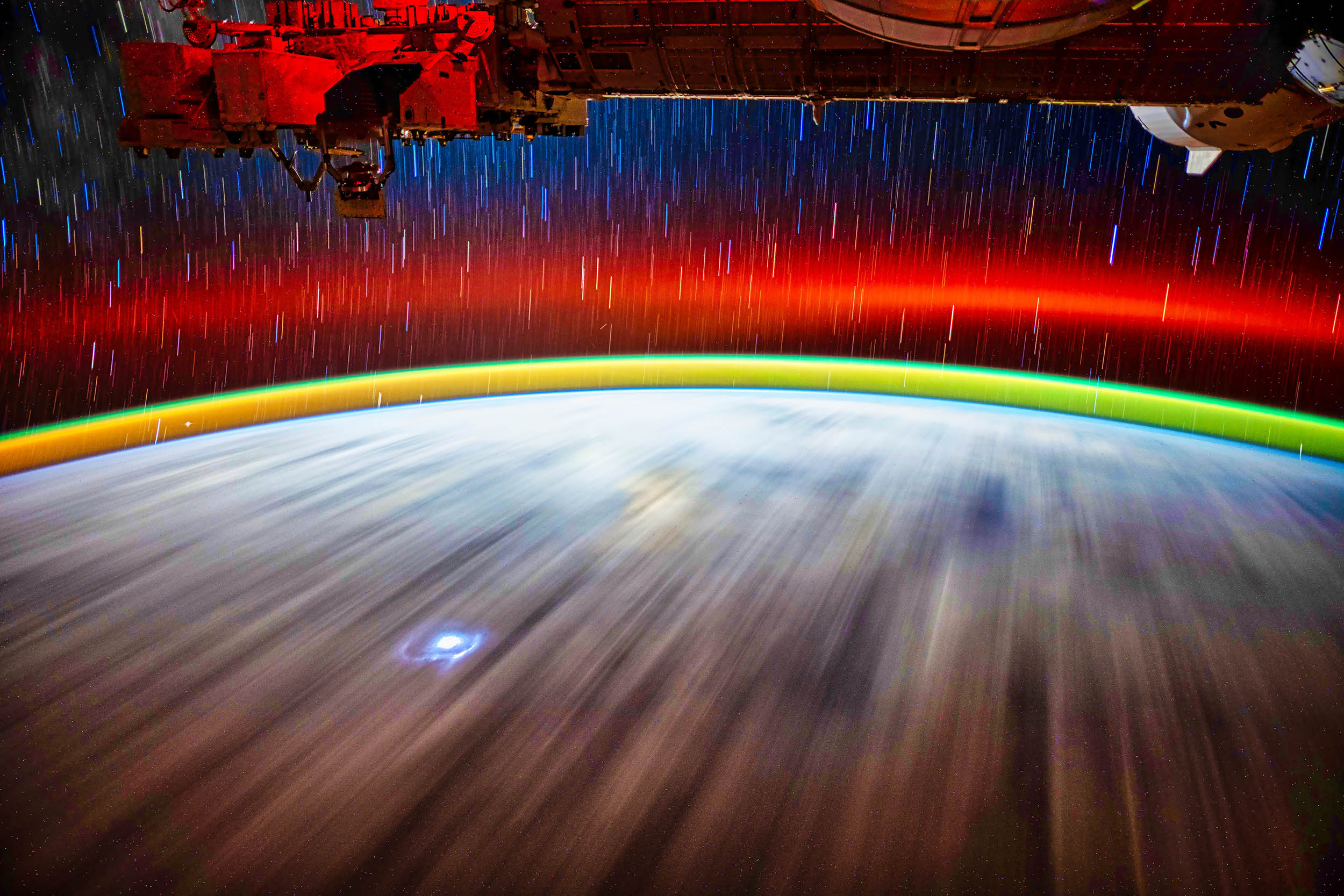
Unseen Echoes: ISS Uncovers a Secret Link Between Earth's Hurricanes and the Edge of Space
The International Space Station (ISS), a beacon of human ingenuity orbiting 250 miles above our planet, has once again unveiled a profound mystery. But this time, the enigma wasn't from deep space; it was an unprecedented atmospheric phenomenon detected a mere 55 miles above Earth, seemingly triggered by the devastating power of Hurricane Helene.
A Hurricane's Reach Extends Beyond the Horizon
When Hurricane Helene tore through the Florida coast, its impact was immediate and catastrophic: relentless rains, winds that buckled structures, and a landscape forever altered. What few might have imagined, however, is that Helene’s destructive energy apparently didn't stop at the troposphere. According to NASA, the ISS instruments picked up a "previously unknown phenomenon surging through Earth's atmosphere" at an altitude far higher than typical weather events.
The Uncharted Territory: 55 Miles Up
Fifty-five miles (approximately 88 kilometers) above Earth places us at the very edge of space, within the lower thermosphere or upper mesosphere – a region where the atmosphere becomes incredibly thin and interactions are typically driven by solar radiation, not terrestrial weather systems. This altitude is well above where commercial aircraft fly and even higher than most atmospheric research balloons can reach. For a terrestrial hurricane, which is a phenomenon of the lower atmosphere, to have an observable, unknown effect at such an extreme height is nothing short of groundbreaking.
What Was Detected?
While NASA's full data analysis is pending, the description of a "surging phenomenon" suggests a powerful transfer of energy. This could manifest as gravity waves propagating upwards, electromagnetic disturbances, or even a form of plasma excitation in the rarefied air. The key is "previously unknown," indicating that existing atmospheric models and observations have not accounted for such a direct and significant coupling between ground-level extreme weather and the very top of our atmosphere.
Rethinking Atmospheric Coupling and Space Weather
This discovery forces scientists to reconsider the intricate connections within Earth's atmospheric layers. Traditionally, space weather refers to conditions in space (primarily solar activity) that can affect Earth. This observation, however, flips the script: could extreme terrestrial weather events like hurricanes also contribute to a form of "terrestrial space weather," influencing conditions at the boundary of our planet and space?
The implications are vast. Understanding this phenomenon could:
- Enhance Climate Models: Incorporate new energy transfer mechanisms from severe storms upwards.
- Improve Spacecraft Operations: Understand potential atmospheric perturbations affecting low Earth orbit satellites.
- Uncover New Physics: Shed light on fundamental interactions between atmospheric dynamics and charged particles at high altitudes.
The NovaPress Perspective: A Frontier Unveiled
At NovaPress, we believe this discovery represents a new frontier in Earth and space science. It highlights the continuous surprises our planet holds and the invaluable role of platforms like the ISS in expanding our knowledge. This isn't just about a hurricane; it's about the intricate, often invisible, dance between Earth's powerful surface events and the cosmic environment it inhabits.
As NASA delves deeper into the data, the scientific community eagerly awaits answers. What exactly was this surge? How often does it occur? And what more secrets do the upper reaches of our atmosphere hold, hidden in plain sight, waiting for the watchful eyes of humanity's orbiting outposts?
The echoes of Hurricane Helene, once thought confined to ravaged coastlines, now resonate at the very edge of space, challenging our understanding and beckoning us to look up, and beyond.