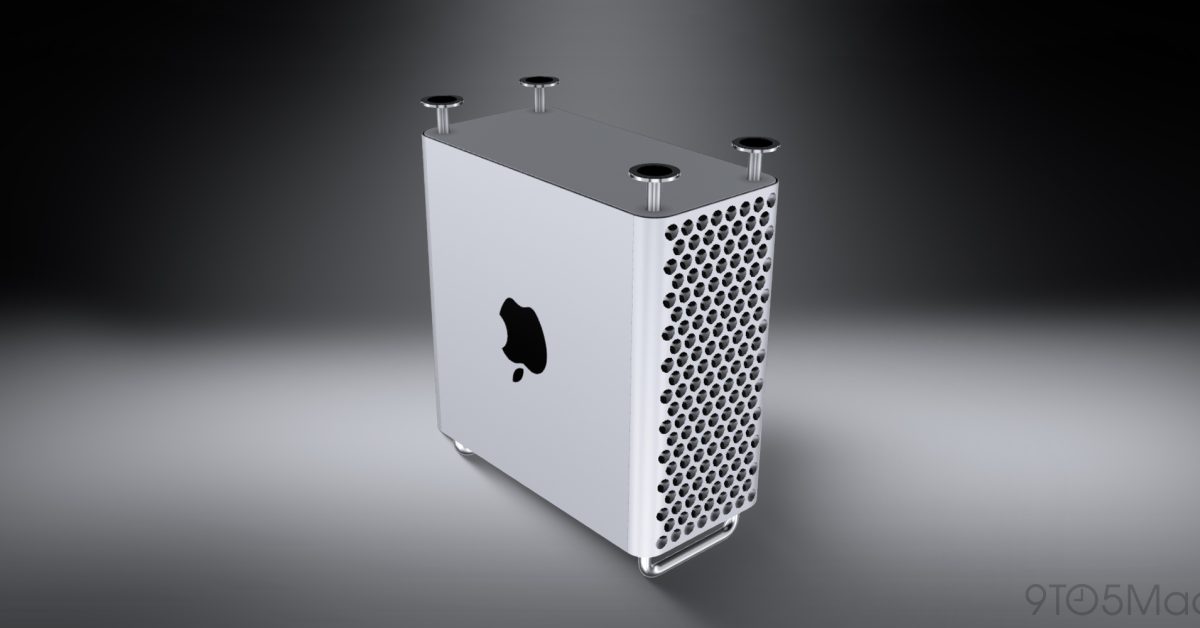
The Sun Sets on a Legend: Apple Discontinues the Mac Pro, Ushering in a New Era of Silicon
In a move that marks a definitive end to an era, Apple has officially confirmed the discontinuation of the Mac Pro. As of Thursday afternoon, the high-end desktop workstation has been removed from Apple’s website, leaving a void in the product lineup previously occupied by its most powerful and customizable machine. For many professionals in creative industries and scientific research, this isn't just a product removal; it's a symbolic shift in Apple's hardware philosophy, deeply intertwined with the ascendance of Apple Silicon.
A Legacy of Uncompromised Power and Pro-Grade Expandability
Since its inception, the Mac Pro name has been synonymous with uncompromised power and expandability. From the iconic G5 Power Mac tower, through the Intel transition with its silver aluminum chassis, to the controversial 'trash can' design of 2013, and finally the return to a modular tower in 2019, the Mac Pro has consistently been Apple's flagship for users demanding the absolute peak of performance, customization, and long-term upgradeability. It was the machine of choice for film editors, 3D animators, software developers, and researchers who needed multi-core Xeon processors, abundant RAM, and crucially, PCI Express slots for specialized expansion cards like high-end GPUs, video capture cards, and fast storage arrays.
The 2019 Mac Pro, in particular, was seen as a direct response to years of pro user complaints about the limitations of the 'trash can' model. Its modular design and MPX Module system offered a return to the kind of internal expandability that many professionals cherished. It was a statement that Apple still cared deeply about the extreme high-end market. So, what changed?
The Apple Silicon Revolution: An Inevitable Obsolescence
The answer lies in Apple's most significant architectural shift in decades: Apple Silicon. The M-series chips, starting with the M1 and culminating in the M2 Ultra, have fundamentally redefined what's possible in terms of performance per watt and integrated architecture. These chips, with their unified memory architecture, powerful neural engines, and integrated GPUs, have delivered staggering performance gains, often outperforming Intel and AMD counterparts in real-world professional applications while consuming a fraction of the power.
The Mac Pro, in its final Intel-based iteration, simply couldn't compete with the efficiency and specific performance advantages offered by Apple Silicon. While it still held an edge in raw CPU core count and certain types of expandability, the gap was rapidly closing, and in many benchmarks, the Mac Studio with an M2 Ultra chip easily surpassed the Intel Mac Pro, especially for tasks optimized for Apple's unified memory and accelerated processing units.
A Niche Shrinks: Evolving Pro Workflows and Product Redundancy
Beyond the technical obsolescence, market dynamics also played a role. The high-end workstation market is a niche, and within Apple's own ecosystem, the Mac Studio, introduced in 2022, effectively cannibalized much of the Mac Pro's potential audience. The Mac Studio delivered incredible M-series performance in a compact form factor, suitable for the vast majority of professionals who previously might have considered a Mac Pro but didn't need its extreme modularity or rack-mount options.
Furthermore, professional workflows themselves are evolving. Cloud computing, virtual machines, and GPU-accelerated rendering services reduce the absolute necessity for every creative professional to own an on-site, fully-loaded workstation. While local processing remains critical for many, the landscape of 'pro' computing is diversifying.
What's Next for the True Pro User?
The discontinuation of the Intel Mac Pro begs the question: what now for those who still require the pinnacle of Apple's desktop offerings? The answer, for now, is almost certainly the Mac Studio. Equipped with the M2 Ultra chip, it represents the most powerful Mac currently available, capable of handling 8K video editing, complex 3D rendering, and massive software compilations with ease.
However, some specific needs remain unaddressed by the Mac Studio, particularly those requiring multiple PCI Express slots for legacy hardware or very specific, high-bandwidth I/O that Thunderbolt ports alone cannot fully replicate. While Apple has hinted at an Apple Silicon Mac Pro in the past, its absence from the latest announcements suggests a strategic re-evaluation. It’s possible Apple believes the Mac Studio covers 99% of its pro user base, or that a future 'Mac Pro' will be an entirely different beast, perhaps an even more extreme iteration of the Apple Silicon architecture, focusing on unprecedented core counts and integrated capabilities rather than traditional internal expansion.
The Broader Implications: A Unified Vision
This move solidifies Apple's commitment to its silicon architecture across its entire product line. It signals a complete break from Intel and a vision where performance, efficiency, and integration are paramount. For Apple, the future is tightly controlled hardware and software co-development, where every component is optimized to work seamlessly together. The Mac Pro, as a highly customizable and expandable platform, was perhaps the last vestige of an older, more open hardware philosophy.
While we bid farewell to the Mac Pro in its traditional form, it's not merely an ending but a transition. It clears the stage for Apple to fully leverage its proprietary chip technology, promising an even more integrated and powerful ecosystem for professionals in the years to come, albeit one that defines 'pro' on its own terms.