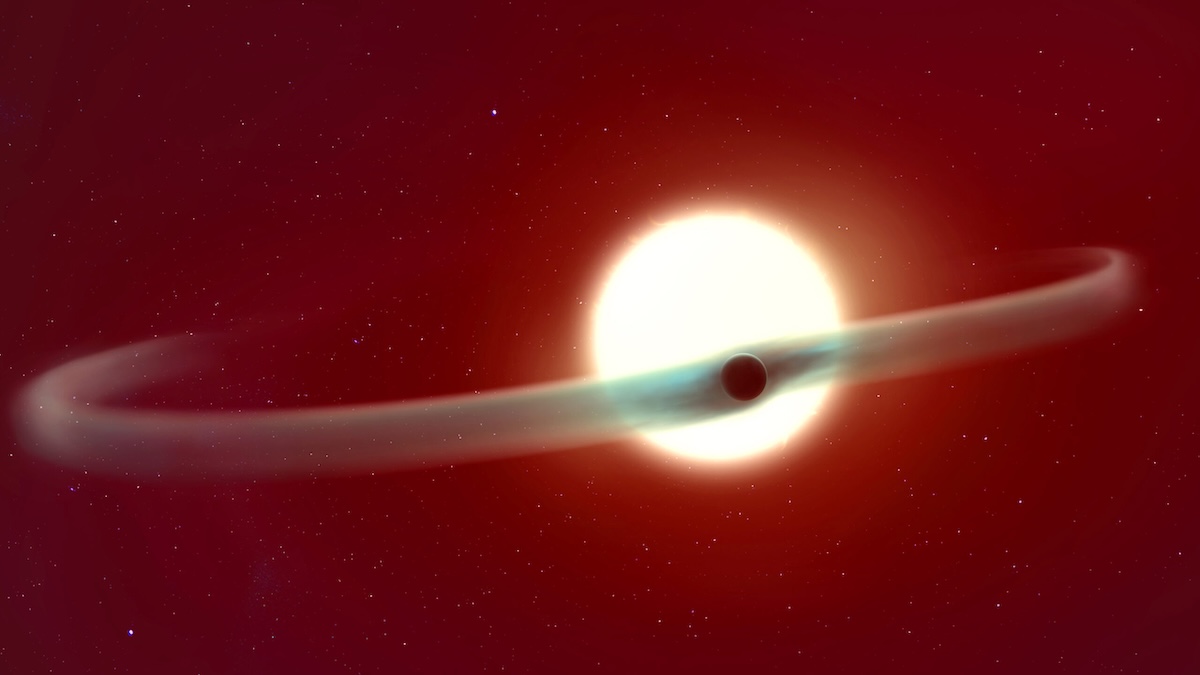
The Great Escape: JWST Captures a Planet's Two-Tailed Saga, Rewriting Our Understanding of Exoplanetary Fates
NovaPress Exclusive: A scorching exoplanet's dramatic atmospheric demise offers unprecedented insights into planetary evolution.
The universe, in its boundless expanse, continues to surprise us with phenomena that challenge and refine our scientific understanding. The latest breathtaking revelation comes courtesy of the James Webb Space Telescope (JWST), which has peered 880 light-years across the cosmos to capture an exoplanet in the throes of a truly spectacular atmospheric escape. This 'hot mess' of a world is not merely losing its atmosphere; it's sculpting two colossal tails of helium, each stretching more than halfway around its host star. This observation isn't just a visual marvel; it's a profound data point reshaping our models of planetary evolution and atmospheric dynamics.
A Cosmic Cascade: Unveiling the Phenomenon
Imagine a planet so close to its star that its very essence is being ripped away, not in a gentle breeze, but in a torrential cosmic wind. That's the dramatic scenario JWST has illuminated. The exoplanet in question, a likely 'hot Jupiter' — a gas giant orbiting exceptionally close to its parent star — is experiencing intense stellar radiation that superheats its outer atmosphere. This extreme energy causes the helium gas to expand rapidly and escape the planet's gravitational pull, streaming out into space. What makes this particular observation record-breaking and unique are the two distinct, enormous tails formed by this escaping helium, a celestial spectacle previously theoretical but now vividly captured.
These tails, extending for mind-boggling distances, represent a significant portion of the planet's atmospheric mass being continuously shed. The sheer scale and clarity with which JWST has resolved this process provide an unprecedented window into the fundamental mechanisms governing atmospheric loss on tidally locked, intensely irradiated worlds. It underscores the dynamic and often violent interplay between stars and their closest planetary companions.
The Mechanics of Atmospheric Demise
Atmospheric escape is a crucial process in planetary evolution, determining whether a planet can retain its gases, and by extension, its potential for habitability. For planets like Earth, our magnetic field and moderate stellar radiation help preserve our protective blanket of air. However, for a hot Jupiter like the one JWST observed, the conditions are vastly different. The intense ultraviolet and X-ray radiation from its nearby star strips away lighter elements like hydrogen and helium with relentless efficiency.
The detection of helium in these prominent tails is particularly insightful. While hydrogen is often the most abundant element in gas giant atmospheres and thus frequently observed escaping, helium detections offer deeper insights into the thermal structure and escape mechanisms of these extreme environments. It suggests a powerful heating mechanism driving even heavier, more inert gases to escape, providing critical data for atmospheric models that aim to predict the long-term fate of such planets.
JWST's Unparalleled Vision: A New Era of Exoplanet Characterization
This discovery is a testament to the unparalleled capabilities of the James Webb Space Telescope. Its sensitive infrared instruments allow astronomers to detect the faint thermal signatures of escaping gases, even across vast interstellar distances. Traditional ground-based telescopes or even its predecessor, Hubble, would struggle to provide such detailed spectroscopic analysis of helium plumes in these extreme conditions.
JWST's ability to probe the chemical composition and dynamics of exoplanet atmospheres is revolutionizing the field. By observing not just the presence of atmospheric components but also their behavior and escape routes, scientists can move beyond mere detection to a comprehensive understanding of exoplanetary environments. This particular observation serves as a powerful validation of JWST's design and its potential to unlock deeper cosmic secrets.
Implications for Planetary Evolution and Habitability
While this particular planet is far too extreme to host life as we know it, the insights gained from its atmospheric escape have profound implications for the broader study of planetary habitability. Understanding how planets lose their atmospheres helps scientists refine models of how planets evolve over billions of years, how long they can retain water, and what conditions are necessary for a stable atmosphere conducive to life.
It also informs our understanding of the 'mini-Neptune desert' – a puzzling absence of exoplanets between the size of Earth and Neptune. Atmospheric escape is one leading theory for how some mini-Neptunes could shed their gas envelopes to become 'super-Earths.' This JWST observation provides tangible evidence for the mechanisms at play, making it a cornerstone for future research into this planetary evolution enigma.
Looking Ahead: The NovaPress Perspective
The dramatic image of a planet with two enormous helium tails is more than just a captivating picture; it's a vital piece of the cosmic puzzle. As Editor-in-Chief of NovaPress, I believe this discovery exemplifies the cutting edge of scientific exploration. It not only expands our knowledge of individual exoplanets but also fundamentally alters our perception of the dynamic and sometimes destructive forces that shape planetary systems across the galaxy.
Future observations with JWST and other advanced telescopes will undoubtedly build upon this foundation, allowing us to characterize more of these 'escaping' worlds, understand the full spectrum of atmospheric loss mechanisms, and ultimately, gain a clearer picture of how planets are born, live, and meet their fates throughout the universe. This record-breaking tail event is just another chapter in humanity's ongoing quest to understand our place in a universe far richer and more complex than we ever imagined.