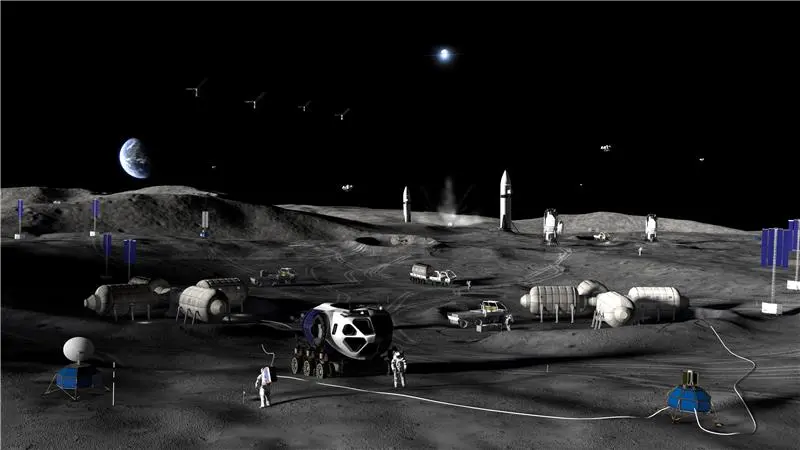
NASA's Bold Pivot: Abandoning Gateway for a Direct Lunar Base Marks a New Era in Space Exploration
By NovaPress Editorial Board - March 25, 202X
In a move that sends ripples throughout the global space community, NASA has announced a significant strategic shift, halting its long-standing plans for the lunar Gateway orbital outpost in favor of an accelerated focus on developing a permanent human base directly on the Moon's surface. This pivot, revealed during an event at NASA Headquarters on March 24, signals a more aggressive and potentially faster path towards sustained human presence beyond Earth.
The Gateway's Ambitious Vision: A Brief Retrospective
For years, the Gateway was envisioned as a cornerstone of NASA's Artemis program. Positioned in a near-rectilinear halo orbit (NRHO) around the Moon, it was designed to serve as a critical staging post for astronauts en route to the lunar surface. It offered a versatile platform for scientific research, technology demonstrations, and a rendezvous point for lunar landers, effectively reducing the travel distance and complexity for missions heading to the Moon's south pole.
The Gateway was also a testament to international collaboration, with significant contributions from the European Space Agency (ESA), Japan Aerospace Exploration Agency (JAXA), and the Canadian Space Agency (CSA), planning modules for habitation, logistics, and robotic arms. It represented a deliberate, step-by-step approach to lunar return, building infrastructure in lunar orbit before committing to long-term surface operations.
The Strategic Pivot: Direct to the Surface
The new directive, however, dramatically alters this trajectory. Instead of building out an orbital station as a primary focus, NASA will now channel resources and expertise directly into establishing a sustainable human presence on the lunar surface. While details are still emerging, the underlying rationale appears to be a desire for greater efficiency and a more direct route to scientific and operational objectives.
"Our objective is clear: to establish a long-term human presence on the Moon. We believe that by focusing our efforts directly on the surface, we can achieve this goal more rapidly and effectively, unlocking unprecedented opportunities for science and exploration." - NASA Official during the announcement.
Rationale and Implications: Why the Change?
Several factors likely influenced this monumental decision. Firstly, the operational complexities and additional time required to utilize an orbital Gateway for every surface mission may have been deemed inefficient for a faster-paced Moon return. A direct-to-surface approach could streamline logistics, reduce reliance on orbital transfers, and potentially accelerate the timeline for achieving continuous human presence.
Secondly, the scientific return from a permanent lunar base promises to be immense. Direct access to lunar regolith, ice deposits at the poles, and an undisturbed environment for astronomical observations offers unparalleled research opportunities. A base allows for sustained geological surveys, resource extraction (ISRU - In-Situ Resource Utilization), and the development of closed-loop life support systems critical for future Mars missions.
The pivot also opens new avenues for commercial partners. While the Gateway offered commercial opportunities, a dedicated lunar base will necessitate a broad array of private sector involvement in everything from habitat construction and power generation to resource mining and logistics services. This could foster a more robust lunar economy sooner than previously anticipated.
Challenges and the Road Ahead
While exciting, this shift is not without its challenges. Developing and deploying complex habitation modules, power systems, and life support infrastructure directly to the lunar surface presents significant engineering and logistical hurdles. The lunar environment, characterized by extreme temperatures, abrasive regolith, and radiation, demands robust and resilient technologies.
Furthermore, the impact on international partners remains a key consideration. Countries that have invested in Gateway-specific modules will now need to re-evaluate their contributions and potentially adapt them for surface-based elements. NASA will undoubtedly engage in detailed discussions to ensure continued strong collaboration on the revised Artemis architecture.
A New Era Dawns
NASA's decision to abandon the Gateway in favor of a direct lunar base marks a definitive turning point. It reflects an evolving strategy focused on efficiency, accelerated timelines, and maximizing scientific and operational returns from lunar exploration. This bold move could very well usher in a new era, transitioning from a series of visits to establishing humanity's first permanent off-world outpost – a critical step not just for the Moon, but for our broader ambitions to reach Mars and beyond.