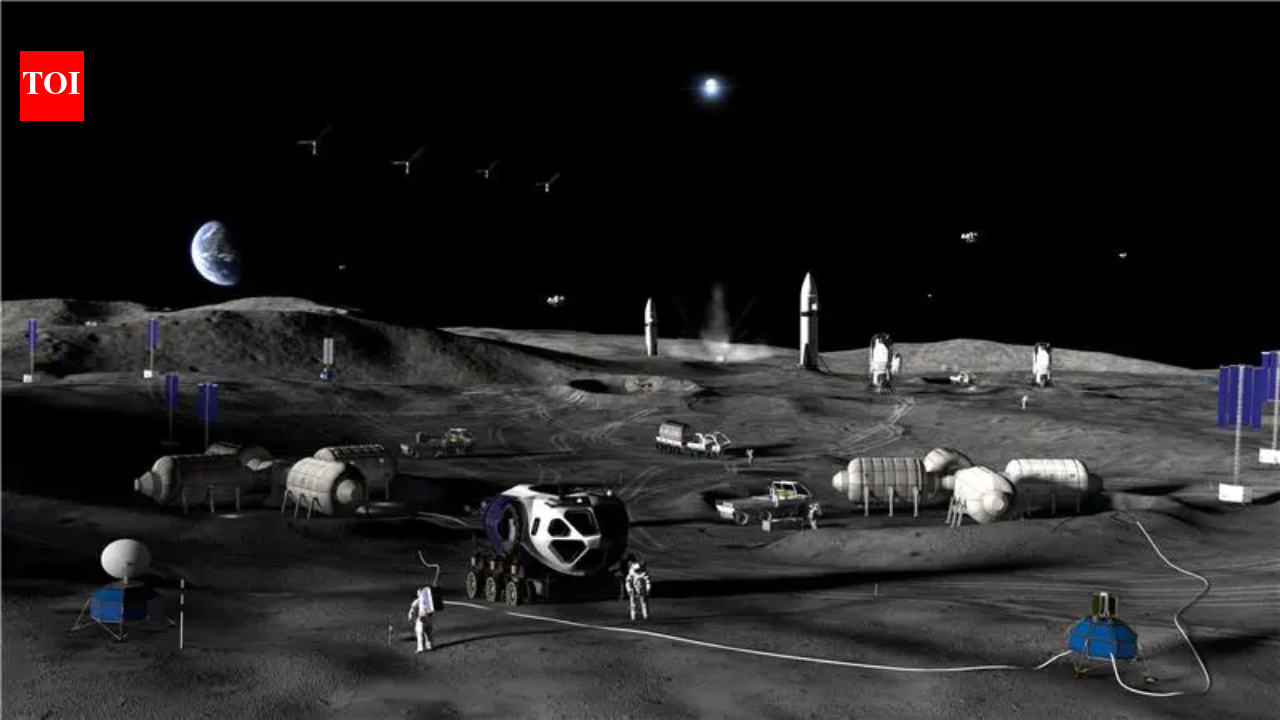
NASA's recent 'Ignition' event marked a pivotal moment in human space exploration, signaling a profound shift from fleeting visits to a steadfast, multi-planetary future. With a declaration as resolute as "US will never give up the Moon again," the agency unveiled an ambitious roadmap that not only accelerates its return to Earth's celestial neighbor but also lays the groundwork for a revolutionary nuclear-powered journey to Mars. This isn't merely about planting flags; it's about establishing a permanent human footprint across the cosmos.
The Lunar Crucible: A Permanent Home on the Moon
For decades since the Apollo era, human presence on the Moon has been aspirational rather than sustained. Now, under the banner of the Artemis program, NASA is engineering a return with an entirely different objective: establishing a permanent, habitable base. This lunar outpost, dubbed the 'Lunar Crucible,' is envisioned as more than just a research station. It will serve as a proving ground for technologies essential for long-duration space habitation, a critical node for resource extraction, and an unparalleled observatory for peering deeper into the universe.
The strategic implications are immense. A permanent lunar presence offers invaluable scientific opportunities, from studying lunar geology and astrobiology to leveraging potential water ice reserves for life support and rocket fuel production. Economically, it paves the way for a burgeoning lunar economy, attracting private sector investment in mining, tourism, and infrastructure development. Geopolitically, it reasserts American leadership in space while potentially fostering new international collaborations, or perhaps, igniting a new era of competitive exploration.
Technological Foundations for Lunar Sustenance
Sustaining a human settlement on the Moon presents formidable challenges. NASA's roadmap includes advancing closed-loop life support systems, developing robust power generation solutions – likely involving advanced solar arrays and potentially small lunar nuclear reactors – and innovating radiation shielding techniques to protect inhabitants from the harsh space environment. Each technological leap made on the Moon will be directly applicable to future missions further into the solar system, especially to Mars.
The Martian Leap: Nuclear Power's Transformative Role
While the Moon serves as a critical first step, Mars remains the ultimate long-term destination for human expansion. NASA's 'Ignition' event brought to the forefront a game-changing element: nuclear propulsion for interplanetary travel. Current chemical rockets, while powerful, make the journey to Mars a multi-month endeavor, posing significant risks to astronaut health due to radiation exposure and muscle atrophy, and limiting mission flexibility.
Nuclear thermal propulsion (NTP) or nuclear electric propulsion (NEP) could dramatically reduce transit times to a matter of weeks. This not only mitigates health risks but also opens larger launch windows, increases payload capacity for essential supplies and equipment, and allows for more robust scientific exploration. The ability to deliver more mass faster fundamentally transforms the feasibility and scope of human missions to Mars.
Overcoming the Nuclear Hurdle
The development and deployment of nuclear propulsion systems are not without significant hurdles. Safety concerns, public perception, and the sheer engineering complexity of integrating a nuclear reactor into a spacecraft demand meticulous design, rigorous testing, and robust regulatory frameworks. However, the potential rewards – a faster, safer, and more capable path to Mars – make this an imperative for NASA's long-term vision of humanity becoming a multi-planetary species.
A New Era of Space Hegemony and Human Destiny
NASA's audacious plans represent more than just technological advancements; they embody a strategic reorientation of human destiny. The commitment to a permanent lunar presence and the pursuit of nuclear propulsion for Mars signals a definitive move towards sustained off-world habitation. This vision carries profound implications for global leadership, economic development, and our understanding of what it means to be human.
As nations like China and private entities like SpaceX also set their sights on lunar and Martian ambitions, NASA's 'Ignition' event may well be remembered as the moment the new space race truly began. It’s a race not just for prestige, but for the very future of humanity, charting a course towards a horizon where Earth is but one of many potential homes.