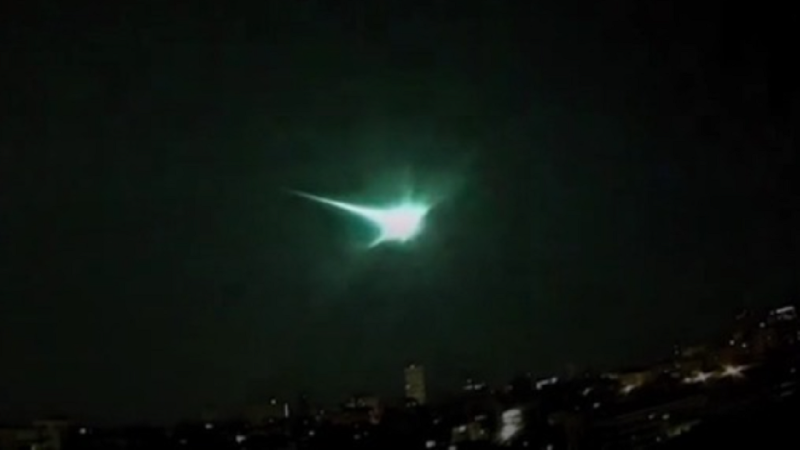
The pre-dawn skies over the Pacific Northwest were pierced by a spectacular and perplexing sight early Monday morning: a "bright green fireball" that captivated eyewitnesses from Oregon to Washington. Reports flooded in, describing a vivid, fast-moving celestial event that illuminated the darkness before vanishing as quickly as it appeared, leaving a trail of wonder and speculation in its wake.
A Dazzling Dawn Phenomenon
Early Monday, around 5:55 AM, multiple residents across the Pacific Northwest region reported seeing an intensely bright, emerald-hued streak across the sky. The Oregon Museum of Science and Industry (OMSI) swiftly confirmed these widespread sightings, acknowledging the extraordinary nature of the event. Such a vivid display is rare, often prompting a mix of awe and curiosity about its origins.
What Causes a Green Fireball?
While "fireball" might conjure images of explosive destruction, in astronomical terms, it simply refers to an exceptionally bright meteor. The striking green hue, however, is a fascinating detail that provides clues about the object's composition. Scientists explain that meteors glow as they ablate – or burn up – from friction with Earth's atmosphere. The specific colors emitted depend on the chemical elements present in the meteoroid.
A predominant green glow is often attributed to the presence of specific metals like nickel, iron, or magnesium. When these elements ionize and excite atmospheric gases, they emit light at particular wavelengths, with magnesium, for instance, known to produce a vibrant blue-green spectrum. This suggests the PNW fireball was likely a fragment of space rock rich in such metallic compounds, turning our atmosphere into a cosmic spectrometer.
From Cosmic Dust to Public Fascination
The event underscores the continuous cosmic ballet occurring above our heads. Earth is constantly bombarded by countless meteoroids, most of which are tiny dust particles that burn up harmlessly. Fireballs, while less common, are a daily occurrence globally, though large, widely observed events like Monday's are more infrequent.
Institutions like OMSI and the American Meteor Society play crucial roles in collecting and analyzing witness reports, often triangulating data to determine trajectories and potential impact zones for meteorites (if any fragments survive atmospheric entry). The increasing accessibility of high-definition dashcams and doorbell cameras also means more of these transient events are captured, contributing valuable data to scientific study.
The Scientific Significance
Beyond the visual spectacle, such events offer invaluable opportunities for scientific research. Analyzing meteorites can provide direct insights into the early solar system, the formation of planets, and the raw materials that make up celestial bodies. Even without a recovered meteorite, the light curve and spectral analysis of a fireball's atmospheric entry can reveal details about its speed, trajectory, and composition.
The PNW fireball serves as a powerful reminder of Earth's dynamic relationship with its cosmic environment. It sparks public interest in astronomy, encouraging people to look up and consider the vastness and wonder of space. While initial reports don't indicate any debris reached the ground, the sheer brilliance and distinctive color of this particular event have cemented its place in the region's recent astronomical history.
Looking Up: What's Next?
As scientists continue to process the collected data, the 'bright green fireball' stands as a captivating testament to the ongoing celestial show above us. For "NovaPress," it's a call to keep our eyes on the skies and our minds open to the universe's endless mysteries. Whether it's a fragment from an ancient asteroid or a piece of space junk, each streaking light tells a story, reminding us of our place in the cosmos.