When Greenland Roared: Unpacking the Global Echoes of a 650-Foot Mega-Tsunami
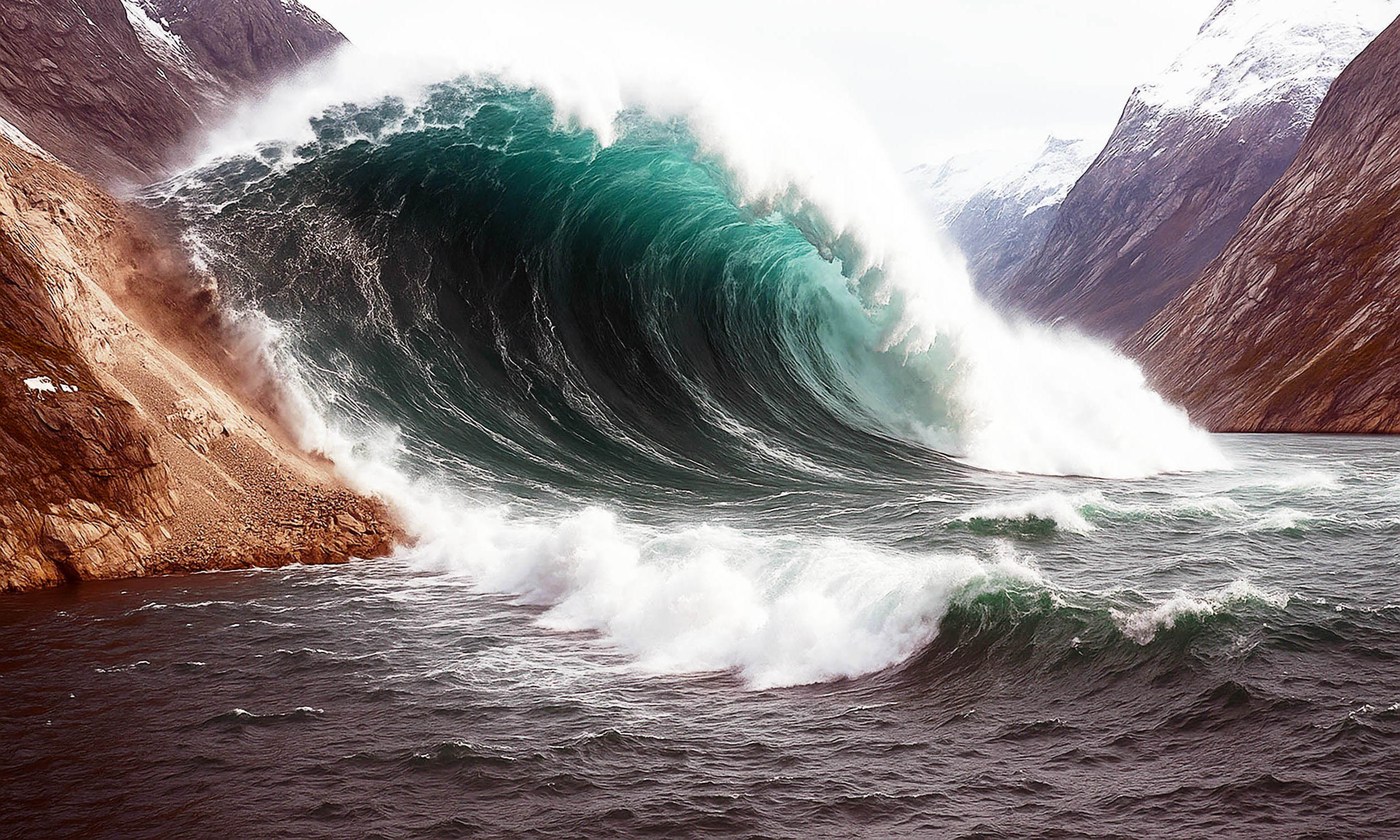
For years, the rugged eastern coast of Greenland sat in an almost pristine, frigid silence, a testament to its remote and untouched grandeur. But then, an instant of unimaginable force shattered this tranquility, sending a jolt through the scientific community and a literal pulse around the globe. What transpired in Greenland's Dickson Fjord was not merely a local catastrophe but a geological event of unprecedented scale, captured by satellites and felt by seismic sensors worldwide: a 650-foot mega-tsunami, whose seismic footprint resonated for nine continuous days.
The Anatomy of a Colossus: Over 25 Million Cubic Yards Unleashed
The genesis of this extraordinary event was a massive rock and ice slide – an estimated 25 million cubic yards of material, roughly equivalent to the volume of 2,000 Olympic-sized swimming pools, violently breaking loose from a towering cliff face. This colossal mass plunged into the narrow confines of Dickson Fjord, an impact that instantly displaced an unimaginable volume of water, generating a monstrous wave that towered an astonishing 650 feet. To put this into perspective, that's taller than the Washington Monument, erupting from the sea.
Global Resonance: Seismic Waves Heard Around the World
While the immediate devastation of such a wave would be localized, the true marvel – and concern – for scientists lay in its secondary effects. The sheer force of the impact and the subsequent movement of such an immense body of water generated seismic waves so powerful that they registered on monitoring stations across the planet. For nine consecutive days, these slow, steady pulses travelled through the Earth's crust, a silent testament to an event that unfolded thousands of miles away. Satellites orbiting overhead provided crucial visual confirmation, capturing the before-and-after of the altered landscape, offering a new dimension to understanding such remote and powerful natural phenomena.
Context and Implications: A Warming World's Warning?
While localized landslides have occurred throughout geological history, the scale and global seismic impact of this Greenland event raise critical questions. Is this an isolated, albeit extreme, natural occurrence, or does it signal a broader trend intensified by a warming climate? Greenland, home to the world's second-largest ice sheet, is a bellwether for climate change. Retreating glaciers can destabilize surrounding rock formations, making cliff faces more prone to collapse. The meltwater from ice can also lubricate existing fault lines, increasing the likelihood of such slides.
Scientists are meticulously analyzing the data from this event, seeking to understand the precise mechanisms at play. The prolonged seismic signal provides an invaluable dataset for seismologists, offering insights into the Earth's internal structure and how energy propagates through it. Furthermore, it highlights the interconnectedness of Earth's systems – a collapse of ice and rock in a remote fjord can send ripples, both literal and figurative, across continents.
Future Outlook: Monitoring and Preparedness in a Changing Landscape
The Greenland mega-tsunami serves as a stark reminder of the planet's dynamic nature and the potential for catastrophic events, particularly in regions undergoing rapid environmental transformation. As polar regions continue to experience significant changes due to rising global temperatures, the frequency and intensity of such glacial and periglacial hazards may increase. This necessitates enhanced monitoring capabilities – both satellite-based and ground-based – to detect early warning signs and improve our predictive models for these complex events.
For coastal communities worldwide, particularly those in fjords or near unstable mountainous terrain, understanding these phenomena is paramount. While the immediate threat from a Greenland mega-tsunami to distant shores is minimal, the event underscores the potential for localized, devastating tsunamis triggered by landslides in vulnerable areas globally. It pushes researchers to refine risk assessments and develop more robust preparedness strategies.
Conclusion: Earth's Unsettled Symphony
The roar from Greenland's Dickson Fjord was a powerful, multi-faceted symphony. It was a symphony of destruction, of geological force, and of global resonance. As scientists continue to decipher its complex notes, this event stands as a potent symbol of our ever-evolving planet, urging us to listen closely to the signals it sends – signals that echo far beyond the immediate point of impact, informing our understanding of Earth's past, present, and uncertain future.