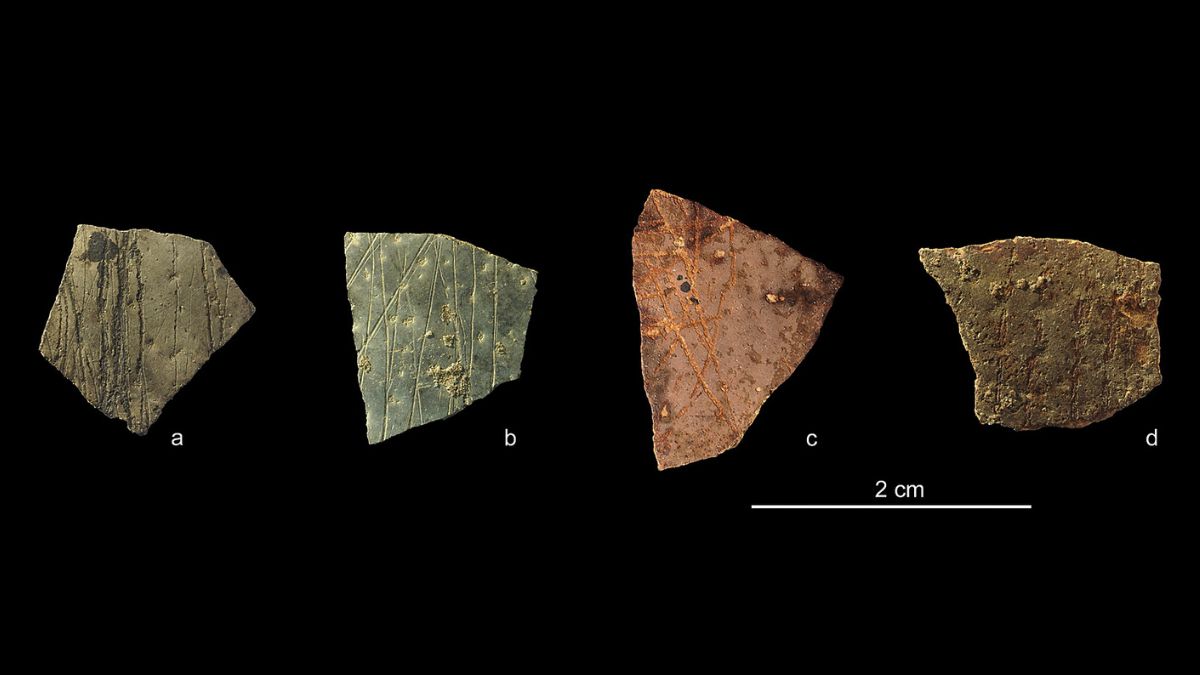
For decades, our understanding of early human intelligence has largely focused on tool-making, fire control, and rudimentary forms of art. But a groundbreaking discovery from the ancient landscapes of southern Africa is forcing a radical re-evaluation of what 'primitive' truly means. Intricately engraved ostrich eggshells, dating back an astonishing 60,000 years, are now considered by many to be the world's oldest known examples of geometric thought, fundamentally reshaping our perception of our ancestors' cognitive capabilities.
The Unearthing of Ancient Intellect
Imagine a canvas as fragile as an eggshell, enduring millennia beneath the earth. Archaeologists across southern Africa have been meticulously unearthing fragments of these ostrich eggshells, originally used as water containers by ancient hunter-gatherers. What sets these particular finds apart is not merely their age, but the deliberate, non-random patterns etched into their surfaces. Researchers describe these engravings as precise, structured, and surprisingly geometric, challenging the long-held notion that abstract mathematical thinking emerged much later in human history.
These aren't simply doodles or decorative markings. The patterns include parallel lines, intersecting lines, and repeating motifs that suggest a clear understanding of spatial relationships and design principles. The meticulousness required to create such consistent patterns on a delicate, curved surface speaks volumes about the engravers' cognitive abilities – their capacity for planning, abstract conceptualization, and fine motor control. This isn't just art; it's a window into an early, sophisticated form of symbolic expression.
Beyond Survival: The Dawn of Abstract Thought
The implication of these discoveries is profound. For ancient humans living 60,000 years ago, life was a constant struggle for survival against the elements, predators, and the scarcity of resources. Yet, amidst these pressures, some individuals were engaging in practices that transcend basic utility. The creation of these geometric patterns points to a cognitive leap – a moment where the human mind began to organize and interpret the world not just through sensory experience, but through abstract representations.
This pushes back the timeline for the development of complex cognitive skills, including:
- Spatial Reasoning: The ability to understand and manipulate objects and shapes in space.
- Pattern Recognition: Identifying and reproducing regularities, a foundational skill for mathematics and science.
- Symbolic Thinking: Attributing meaning beyond the literal, essential for language, art, and complex social structures.
Contextualizing a Cognitive Revolution
While other early symbolic artifacts, such as ochre carvings and shell beads, have been found from similar periods, the geometric precision of these ostrich eggshells provides a unique insight. It indicates not just an aesthetic sensibility, but a structured approach to design that borders on proto-mathematics. Were these patterns mere decoration? Or did they convey information, perhaps related to territorial markers, social status, or even early calendrical systems? The answers remain elusive, but the questions themselves expand our understanding of the rich inner lives of our ancestors.
This research compels us to reconsider the linearity of human cultural evolution. It argues against the idea of a sudden 'cognitive revolution' and instead proposes a more gradual, complex unfolding of human intellectual capabilities, with sophisticated forms of thought emerging much earlier and perhaps in more diverse ways than previously acknowledged.
The Future Implications for Anthropology and Science
The 'NovaPress' views this discovery as a critical milestone. It underscores the importance of interdisciplinary research, combining archaeology, anthropology, cognitive science, and even mathematics, to unlock the secrets of our past. Future research will undoubtedly focus on discovering more such artifacts, refining dating techniques, and analyzing the precise mathematical properties of these ancient designs.
Moreover, this finding encourages a broader perspective on the universality of mathematical concepts. It suggests that the impulse to recognize, create, and understand patterns is deeply ingrained in the human psyche, spanning across cultures and time periods. Our ancestors were not merely surviving; they were thinking, creating, and perhaps, laying the very groundwork for the complex societies and scientific advancements we see today.
The engraved ostrich eggshells from southern Africa are more than just ancient fragments; they are a testament to the enduring creativity and structured thinking of humanity, a 60,000-year-old message reminding us of the profound intellectual heritage we all share.