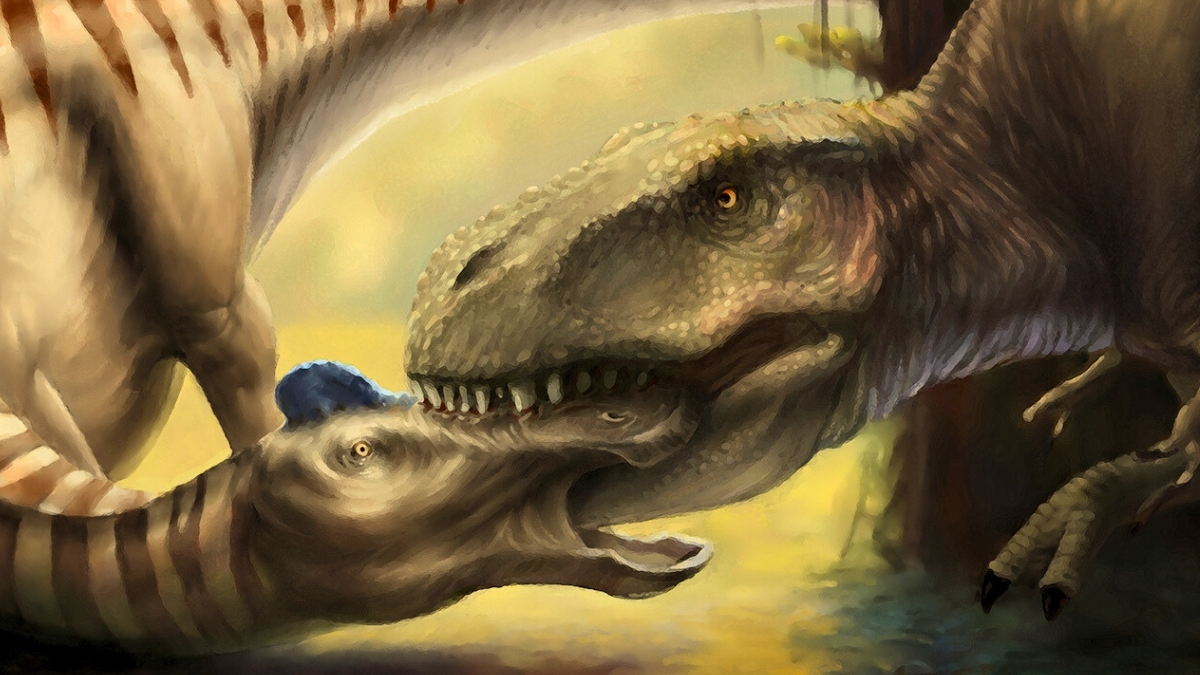
Shattering the Scavenger Myth: T. Rex's Predatory Prowess Confirmed by a Single, Deadly Tooth
The Tyrannosaurus rex. For generations, its very name has conjured images of the ultimate prehistoric predator, a behemoth ruling the Late Cretaceous period. Yet, despite its fearsome reputation amplified by pop culture, the scientific community has long grappled with a persistent debate: was T. rex primarily a hunter, or a colossal scavenger? A groundbreaking discovery, a T. rex tooth found embedded in the fossilized skull of another dinosaur, has finally provided definitive evidence, tipping the scales decisively in favor of the apex predator.
The Enduring T. Rex Debate: Hunter or Opportunist?
The T. rex's role in its ancient ecosystem has been a subject of intense paleontological discussion. Early depictions often portrayed it as an active, powerful hunter, a view largely fueled by its intimidating size and colossal teeth. However, in recent decades, some researchers proposed a more nuanced, even scavenger-centric view. This hypothesis was supported by arguments citing its relatively small eyes compared to its overall head size, large olfactory bulbs suggesting a keen sense of smell for locating carrion, and seemingly slow speed relative to its immense bulk. Proponents of the scavenger theory argued that its massive jaws and bone-crushing dentition were better suited for extracting marrow from carcasses rather than dispatching agile, living prey.
The Irrefutable Evidence: A Tooth in the Skull
The latest discovery, meticulously detailed by paleontologists, offers a concrete and irrefutable piece of evidence against the pure scavenger hypothesis. Finding a T. rex tooth *embedded directly* within the bone of another dinosaur's skull is not merely suggestive; it is conclusive proof of direct, aggressive interaction. This isn't a case of a tooth falling out near a carcass, or a tooth swallowed during scavenging. The tooth's precise placement indicates a forceful impact, a direct bite into a living or recently deceased creature during a struggle or a kill. While the specific prey dinosaur is not detailed in the initial reports, the implication of a tooth firmly lodged *in the skull* is profound. It demonstrates the immense bite force and the direct, violent intent of the T. rex to engage with another large dinosaur, leaving a permanent mark of its predatory prowess.
Reaffirming the Apex Predator's Reign
This finding powerfully reinforces the image of T. rex as an active and fearsome hunter. Its legendary bite force, estimated to be the strongest of any terrestrial animal, would have been deployed with devastating effect. The discovery speaks volumes about its predatory strategy – a direct, powerful attack capable of incapacitating large prey. This evidence aligns with other indicators of T. rex's predatory lifestyle, such as its robust hind limbs built for pursuit, its binocular vision (allowing for crucial depth perception), and its robust, bone-crushing dentition designed for dismembering and consuming large prey. The embedded tooth serves as a fossilized snapshot of a violent struggle, a testament to the brutal realities of life in the Late Cretaceous period.
Broader Paleontological Implications and Future Discoveries
Beyond solidifying the T. rex's predatory status, this discovery highlights the dynamic nature of paleontological research. Every new fossil find has the potential to challenge, confirm, or completely reshape our understanding of prehistoric life. It underscores the importance of empirical evidence over theoretical speculation and the continuous evolution of scientific knowledge. Such discoveries allow scientists to reconstruct ancient food webs with greater accuracy, understanding the intricate predator-prey relationships that governed these bygone ecosystems. It reminds us that our knowledge of dinosaurs is ever-evolving, built one fossil, one bone, one embedded tooth at a time.
The enduring allure of the T. rex is now bolstered by unequivocal scientific validation of its role as a supreme predator. The finding of a single tooth, a seemingly small detail in the grand tapestry of prehistory, has resolved a decades-long debate and painted a clearer, more thrilling picture of this iconic dinosaur. As paleontologists continue to unearth the secrets of the past, each discovery brings us closer to truly understanding the magnificent and terrifying creatures that once roamed our planet, cementing their place not just in popular imagination, but in the annals of scientific fact.