Unlocking Earth's Past: How 3 Million Years of Stable CO2 Levels Puts Today's Climate Crisis in Sharp Relief
For millions of years, Earth's atmosphere maintained a delicate balance, its critical greenhouse gas levels oscillating within a remarkably stable range. Groundbreaking research, drawing on invaluable 'blue ice' records from the depths of Antarctica, has painted a vivid picture of this ancient atmospheric equilibrium. The findings, published in leading scientific journals like Nature, reveal a profound truth: the current surge in atmospheric carbon dioxide (CO2) and methane (CH4) is not merely a fluctuation, but an unprecedented departure from millennia of natural stability.
The Silent Archives: Antarctic Ice Cores as Climate Time Capsules
The bedrock of this understanding lies in the silent, frozen archives of Antarctica. Scientists extract ice cores, cylindrical samples of ice that can stretch kilometers deep, representing layers of snowfall accumulated over hundreds of thousands, even millions, of years. Trapped within tiny air bubbles in these ancient ice layers are pristine samples of Earth's past atmosphere. By analyzing the chemical composition of these trapped gases, researchers can reconstruct historical concentrations of greenhouse gases like CO2 and CH4 with remarkable precision.
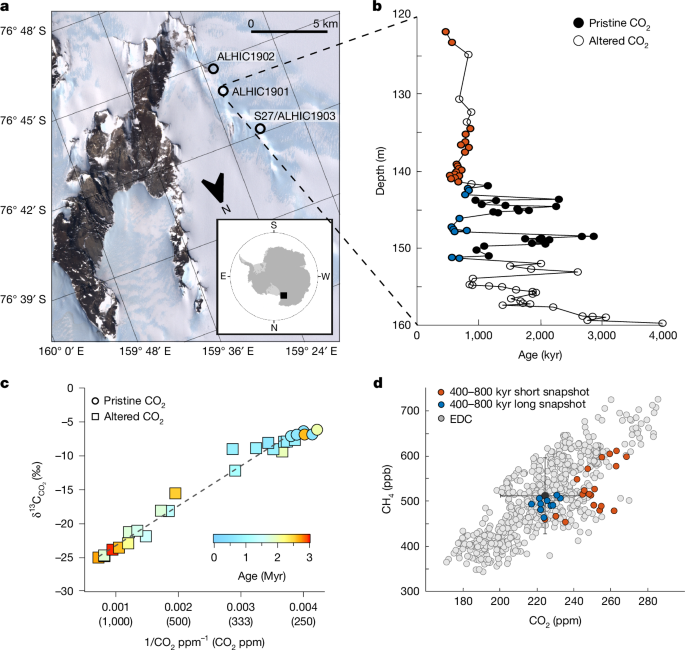
The research referenced, including seminal works by Lüthi, Bereiter, and others, leverages these blue ice records—an even older and more compressed form of ice found in specific Antarctic regions—to extend our atmospheric timeline back an astonishing three million years. This incredible dataset provides an unparalleled backdrop against which to evaluate contemporary atmospheric changes.
A Three-Million-Year Baseline: The Rhythm of Natural Cycles
What these ancient ice records overwhelmingly show is a pattern of 'broadly stable' atmospheric CO2 and CH4 levels. Over three million years, Earth experienced numerous glacial and interglacial cycles – periods of intense cold followed by warmer intervals. During these cycles, greenhouse gas concentrations naturally fluctuated, driving and responding to shifts in global climate. CO2 levels, for instance, typically varied between approximately 180 parts per million (ppm) during deep glacial periods and around 280-300 ppm during warmer interglacials.
Crucially, these fluctuations, while significant in shaping past climates, remained within a relatively narrow, predictable natural boundary. The Earth system, through its vast carbon sinks, oceanic absorption, and biological processes, had mechanisms to regulate and reset these levels, maintaining a long-term dynamic equilibrium. This historical stability underscores the resilience and self-regulating capacity of our planet's natural systems, but also highlights their limits.
The Anthropocene Anomaly: Breaking the Million-Year Trend
The stark contrast emerges when we look at the most recent chapters of Earth's atmospheric history. Since the onset of the Industrial Revolution, roughly 200 years ago, humanity's reliance on fossil fuels, deforestation, and industrial processes has injected unprecedented amounts of CO2 and CH4 into the atmosphere. Today, atmospheric CO2 concentrations have soared past 420 ppm—a level not seen on Earth for at least three million years, and potentially much longer. Similarly, methane levels have dramatically increased.
It's not just the absolute levels that are alarming, but the rate of increase. The current pace of greenhouse gas accumulation is orders of magnitude faster than any natural increase observed in the three-million-year ice core record. This rapid, human-driven perturbation is overwhelming the Earth's natural systems, which simply cannot absorb or process these emissions quickly enough to restore the ancient balance.
Profound Implications: A Warning from Earth's Past
The historical perspective offered by these Antarctic ice cores is more than just an academic curiosity; it's a profound warning. It demonstrates unequivocally that current atmospheric greenhouse gas levels are not part of any natural cycle. They represent a fundamental shift, a human-induced experiment on a planetary scale, pushing Earth's climate system into uncharted territory.
Understanding the long-term stability of past CO2 and CH4 levels provides crucial context for predicting future climate scenarios. When the planet has maintained certain atmospheric conditions for millions of years, deviating so sharply and rapidly carries immense risks – from accelerated global warming and sea-level rise to more extreme weather events and widespread ecological disruption. The ice cores tell us that the Earth has a stable range, and we are currently far outside it.
Conclusion: Heeding the Ice's Silent Testimony
The painstaking work of paleoclimate scientists, meticulously extracting and analyzing ancient ice, offers humanity an invaluable mirror to its past and a guide for its future. The three-million-year record of broadly stable atmospheric CO2 and CH4 levels stands as a testament to the Earth's natural equilibrium. Our current trajectory, however, marks a dramatic and dangerous departure from this deep-time stability.
As we confront the escalating climate crisis, the silent testimony of the Antarctic ice provides undeniable evidence of human impact. It underscores the urgency of transitioning to sustainable practices, reducing greenhouse gas emissions, and working collectively to restore some semblance of the atmospheric balance that prevailed for millions of years before our time. The planet has spoken through its ice; now it is up to us to listen and act.