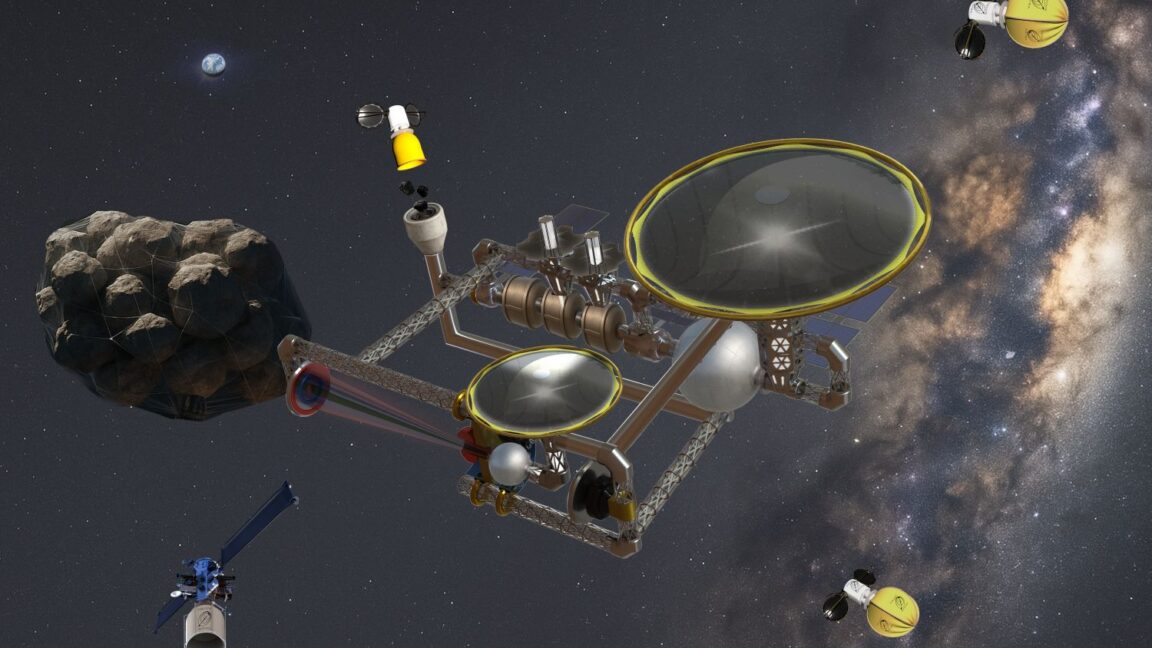
Cosmic Heist: How a Private Company Aims to Capture an Asteroid and Usher in a New Era of Space Resources
By NovaPress Editorial Board
The whispers of a new space race have long been circulating, but a recent revelation from Ars Technica suggests we're on the cusp of a cosmic heist unlike any imagined. A private space company, building on previously tested technology aboard the International Space Station, has unveiled a "radical new plan to bag an asteroid." This isn't merely about observation or fly-bys; it's about capture, control, and potentially, ushering in an era of unprecedented resource availability and off-world industry.
The Audacious Goal: Why Bag an Asteroid?
For decades, asteroids have been viewed as scientific curiosities or potential planetary threats. However, their true value lies in their composition. Many asteroids are veritable treasure troves of precious metals (platinum, gold, nickel, iron) and volatile compounds (water ice, ammonia), vital for life support and fuel in deep space. Successfully 'bagging' an asteroid could mean:
- Unlocking In-Situ Resource Utilization (ISRU): Providing essential materials for constructing habitats, spacecraft, and fuel depots directly in space, drastically reducing launch costs from Earth.
- Fueling Deep Space Exploration: Water ice can be split into hydrogen and oxygen—rocket fuel—making missions to Mars and beyond more feasible and sustainable.
- Earth-Bound Resource Augmentation: Though controversial, bringing asteroid materials back to Earth could potentially alleviate terrestrial resource scarcity, though the economics remain challenging.
- Planetary Defense: Understanding asteroid dynamics and developing capture capabilities could also enhance our ability to deflect or mitigate potential impact threats.
From ISS Tests to Interplanetary Capture: The Technology at Play
The company's claim of having "previously tested its technology on the International Space Station" is a crucial detail. The ISS serves as a unique microgravity laboratory, allowing for the validation of systems in a space environment without the full commitment of an interplanetary mission. While specifics of the "bagging" technology remain under wraps, it likely involves a combination of:
- Advanced Robotics and Autonomous Systems: Precision maneuvering and capture require sophisticated AI and robotic arms, potentially an evolution of technologies already present on the ISS for cargo handling or external maintenance.
- Flexible Containment or Tethers: The term "bag" suggests a non-rigid capture mechanism, perhaps a large deployable net or fabric enclosure designed to safely envelop an irregularly shaped, spinning celestial body. This would minimize damage to the asteroid and the capture vehicle.
- Low-Thrust Propulsion and Gravitational Tractor Principles: To safely de-spin and redirect an asteroid, extremely precise and gentle forces are needed. Ion thrusters or even a "gravitational tractor" (using the spacecraft's own gravity to nudge the asteroid) could be employed over long durations.
The challenge is immense: approaching a free-spinning object, matching its velocity, securing it without breaking it apart, and then gently nudging it into a desired trajectory – perhaps a stable orbit around the Moon or even Earth itself.
Future Implications: A New Cosmic Economy?
If successful, this venture would not only be a monumental engineering feat but also a profound catalyst for a new space economy. The availability of off-world resources could dramatically lower the cost of space operations, fueling a virtuous cycle of innovation and expansion. Imagine self-sustaining lunar bases, orbital manufacturing facilities, and even deep-space human settlements built from materials sourced directly from the cosmos.
However, this radical future is not without its challenges. The legal framework for asteroid ownership and resource extraction is still nascent and complex. International treaties like the Outer Space Treaty of 1967 declare space as the "province of all mankind," prohibiting national appropriation. Private enterprise, however, operates in a grey area, and establishing clear, equitable rules will be paramount to prevent a new form of "cosmic land grab." Environmental concerns, albeit on a celestial scale, also arise regarding the potential alteration of asteroid trajectories or the introduction of contaminants.
NovaPress Outlook
The ambition to "bag an asteroid" represents a significant leap from current space endeavors. It signifies a shift from mere exploration to active utilization of the space environment. While formidable technical, economic, and ethical hurdles remain, the groundwork laid on the ISS offers a compelling glimpse into a future where humanity's reach extends far beyond our home planet, unlocking resources that could redefine our civilization. NovaPress will continue to monitor this groundbreaking development, ready to report on the next chapter of this cosmic adventure.