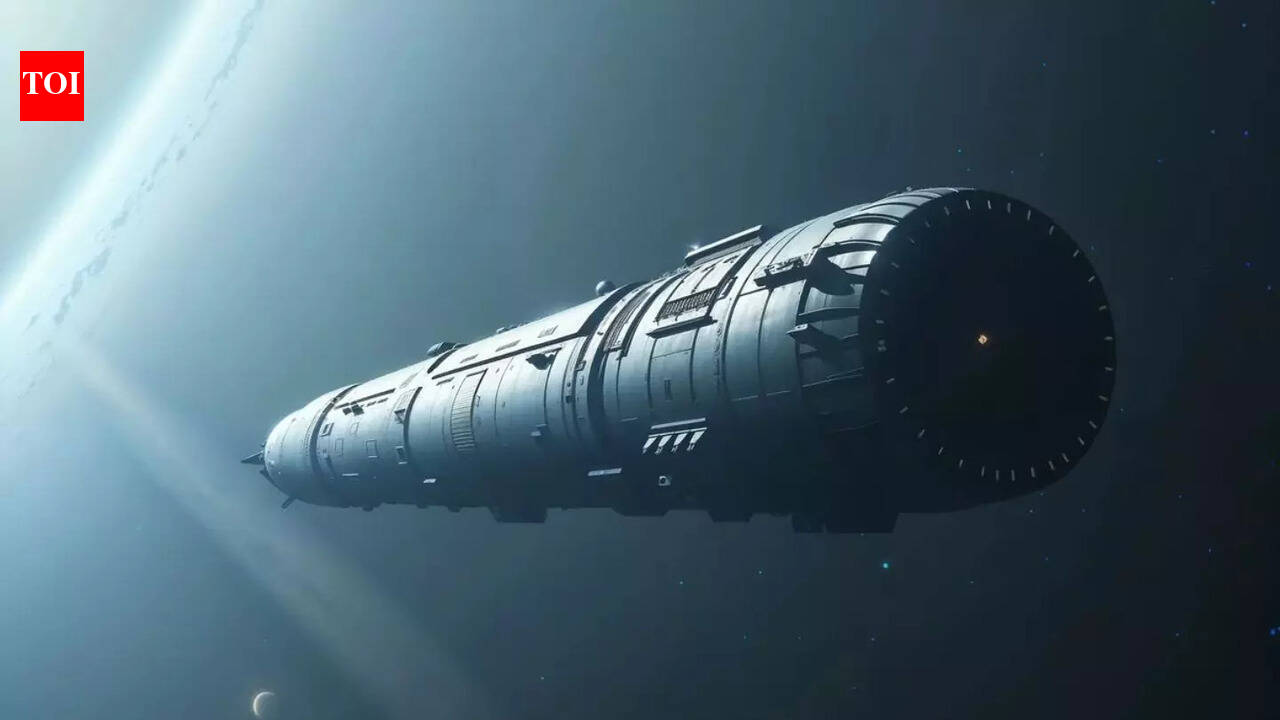
The Chrysalis Project: Humanity's 36-Mile Ark and the Audacious Dream of Interstellar Survival
In the annals of human ambition, few concepts rival the sheer scale and profound implications of the Chrysalis. Proposed as a one-way generational starship, this colossal vessel – an astounding 36 miles in length – is designed to transport 1,000 humans for a quarter of a millennium into the deep interstellar void. It is not merely a mode of transport; it is a self-contained world, an ark for a fragment of humanity, and a testament to our species' indomitable will to survive and explore.
A Self-Contained Universe: Life Aboard the Chrysalis
Imagine a vessel so immense that it transcends the very definition of a ship, becoming a miniature planet unto itself. The 36-mile length of the Chrysalis hints at internal ecosystems, vast enough to sustain a thousand lives for 250 years. This isn't just about oxygen and food; it's about a complete ecological balance. We're talking closed-loop systems for water recycling, waste management, and atmospheric regeneration. Agricultural domes and hydroponic farms would likely span acres, producing sustenance for generations. Beyond basic needs, the design must account for biodiversity, perhaps even small biomes to support mental well-being and a sense of 'natural' environment.
Such a structure would necessitate artificial gravity, likely achieved through constant rotation, to prevent the debilitating effects of zero-g over such an extended period. This rotational force would also define the internal geography, creating a sense of 'up' and 'down' that allows for architecture, infrastructure, and a semblance of normal life. Schools, hospitals, community centers, and even recreational areas would need to be meticulously planned, not just for the initial settlers but for their descendants, who will know no other home.
The Generational Leap: A Society Forged in Transit
The "generational" aspect of Chrysalis is perhaps its most profound and challenging feature. The original 1,000 voyagers will never see the destination. Their lives, and the lives of several subsequent generations, will be lived entirely in transit. This necessitates the establishment of a robust and adaptable societal structure. How would governance evolve over 250 years? What cultural norms would emerge in such an isolated, tightly-knit community? Education would be paramount, ensuring the accumulated knowledge and skills of humanity are passed down, alongside the specific training required to operate and maintain the starship.
The psychological toll of such a journey cannot be overstated. Generations born and raised knowing only the metallic confines and artificial skies of Chrysalis, yet tasked with a mission initiated by their distant ancestors, would face unique existential questions. Maintaining morale, purpose, and a sense of collective identity would be critical. This isn't just about preserving human life, but preserving human culture and spirit across the vast emptiness of space and time.
Technological Marvels and Unforeseen Challenges
While the source data is light on specifics, the very concept of Chrysalis implies a suite of unprecedented technological advancements. Propulsion systems capable of achieving significant fractions of the speed of light would be essential to cover interstellar distances within a 250-year timeframe, even for a one-way trip. Protecting the vessel and its inhabitants from cosmic radiation, micro-meteoroids, and other interstellar hazards would require advanced shielding materials and detection systems.
Energy generation, likely relying on advanced fusion reactors or other high-yield, long-duration power sources, would be the heart of the ship. Communication with a distant Earth, if even possible or desired after generations, would face incredible time lags, making real-time interaction impossible. The engineering challenges alone are staggering, demanding breakthroughs in material science, AI for autonomous maintenance, and system redundancy to ensure survival over centuries.
The Ethical Compass of Interstellar Migration
Beyond the technical feasibility lies a complex web of ethical considerations. Who decides who goes on such a journey? What criteria are used for selection? Is it a self-imposed exile, a scientific mission, or a desperate last resort? The decision to embark on a one-way journey, sacrificing any return to Earth, is a monumental one, both for the individuals and for the species they represent. It's a gamble with humanity's future, a testament to our drive to escape existential threats or simply to explore beyond our cradle.
The long-term success isn't just about survival; it's about the kind of civilization that arrives at the destination. Will they remember their origins, their mission? Will they thrive, or merely endure? The Chrysalis project forces us to confront not just our capacity for engineering marvels, but our responsibility to future generations and the very definition of what it means to be human in the cosmos.
Chrysalis: A Blueprint for Tomorrow's Stars
The Chrysalis, even as a theoretical proposal, represents a pivotal shift in humanity's spacefaring ambitions. It moves beyond short-term missions and orbital stations, daring to imagine a future where humanity is not just visiting space but truly living in it, for centuries, across unimaginable distances. It's a beacon for a future where the human spirit, armed with ingenuity and resilience, refuses to be confined to a single planet.
Whether the Chrysalis ever leaves the drawing board or takes to the stars, its concept alone serves as a powerful thought experiment. It challenges us to envision solutions to problems that span generations, pushing the boundaries of technology, sociology, and ethics. It reminds us that while our home planet remains our most precious asset, the universe beckons with endless possibilities—and perhaps, an ultimate destiny among the stars.