For generations, the image of the Neanderthal has been that of a brutish, primitive caveman, an evolutionary dead-end overshadowed by the rise of modern humans. This persistent stereotype has dictated our understanding of their capabilities, particularly when it comes to technology and complex social organization. However, a groundbreaking discovery in a German hill is not just rewriting textbooks; it's shattering centuries of misconceptions, revealing a level of industrial sophistication among Neanderthals that predates humanity’s accepted timeline of innovation by a staggering 125,000 years.
The German Hill: An Unlikely Cradle of Industry
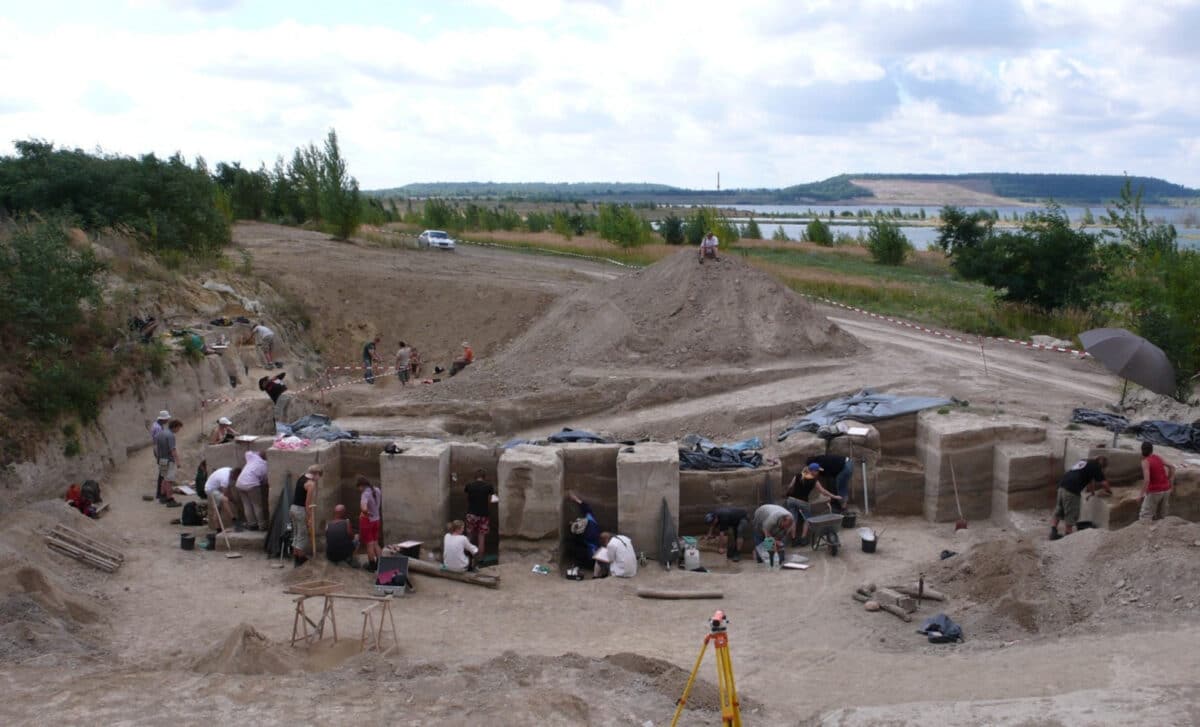
Archaeologists digging deep into a site in Germany have unearthed what can only be described as a Neanderthal "factory." This isn't a quaint workshop; it's a meticulously organized bone grease production facility, operating with a systematic efficiency that remarkably parallels the concepts of assembly-line production and resource management more commonly associated with industrial giants like Henry Ford. The sheer age of the site — 125,000 years old — is a seismic shock to the foundations of archaeological thought.
The Neanderthal Assembly Line: Precision in Prehistory
What makes this discovery so revolutionary is not just the product (bone grease) but the process. Scientists describe the operation as running "like clockwork," indicating a standardized sequence of activities, specialized tools, and a division of labor previously attributed only to much later human societies. The production of bone grease is a labor-intensive endeavor: bones must be collected, crushed, heated to extract marrow and fat, and then processed further. To execute this on what appears to be an industrial scale suggests advanced planning, collective effort, and perhaps even a form of early proto-management. This wasn't merely opportunistic foraging; it was a deliberate, large-scale manufacturing process aimed at producing a valuable resource.
Bone Grease: The Ancient Super-Resource
Why bone grease? This seemingly humble product was a vital commodity for ancient hominins. Rich in calories and highly portable, it could be used as a concentrated food source, crucial for survival during lean times. Beyond sustenance, bone grease served as a versatile fuel for lamps, a waterproofing agent for hides and tools, and even a binder for pigments in art or body paint. The ability to produce it systematically and in significant quantities speaks volumes about Neanderthal foresight and their understanding of resource utility and preservation. It highlights a sophisticated adaptive strategy, moving beyond mere survival to proactive resource management and technological application.
Shattering the "Brutish Caveman" Stereotype
This discovery fundamentally challenges the long-held perception of Neanderthals as intellectually inferior to Homo sapiens. The level of organization, technological ingenuity, and foresight required to establish and run such a factory demands a re-evaluation of their cognitive abilities. It suggests complex social structures, effective communication, and perhaps even a rudimentary economy centered around resource production and distribution. This wasn't just tool-making; it was industrial-scale production for a clear, multifaceted purpose. This puts Neanderthals firmly in the realm of complex problem-solvers and innovators, not just crude survivalists.
Echoes of Ford: Prehistoric Industrial Revolution?
The comparison to Henry Ford’s 1913 assembly line, while anachronistic, serves a powerful rhetorical purpose. It highlights the core principle of breaking down a complex task into manageable, repeatable steps for efficient mass production. While the scale and technology were vastly different, the underlying logic of optimizing output through systematic processing appears to have been understood and implemented by Neanderthals more than a hundred millennia ago. This revelation pushes the origins of what we consider 'industrial' thought deep into prehistory, forcing us to reconsider the timeline of human technological and organizational evolution.
The Future of Prehistoric Archaeology
The implications of this find are profound. It opens up new avenues for archaeological research, prompting questions about other potential Neanderthal industrial sites or similar complex operations that may have been overlooked. It encourages a fresh look at existing finds through a new lens, seeking evidence of systematic production rather than just individual artifacts. This discovery doesn't just rewrite a chapter; it demands a complete overhaul of our understanding of Neanderthal intelligence, culture, and their undeniable contribution to the grand tapestry of human innovation.
As we continue to dig deeper, both literally and figuratively, into our shared past, the Neanderthals are emerging not as a footnote in human history, but as sophisticated, innovative architects of early technology, whose ingenuity laid foundations we are only now beginning to fully appreciate.