The Enigma of the Eight-Billion-Light-Year Laser: MeerKAT's Unexplained Signal Reshapes Cosmic Understanding
In the vast, silent expanse of the cosmos, astronomers constantly listen for whispers and shouts from distant galaxies. Yet, a recent detection by the MeerKAT radio telescope has sent more than just a whisper; it's a blaring, razor-thin signal from 8 billion light-years away that refuses to conform to any known rules of astrophysics. This isn't just another faint echo from the early universe; it's a 'mega-laser' beam, unbelievably bright and stubbornly persistent, challenging our fundamental understanding of cosmic phenomena.
A Signal Beyond Comprehension
The MeerKAT radio telescope, nestled in the Karoo desert of South Africa, is renowned for its unparalleled sensitivity and imaging capabilities. While sifting through petabytes of data, a peculiar anomaly surfaced: a strikingly thin line of radio emission, occupying a familiar part of the radio spectrum, yet radiating with an intensity that defied its immense distance. Typically, signals weaken dramatically over such cosmological scales, attenuated by the sheer volume of intervening space and the expansion of the universe. For a signal to remain 'stubbornly bright' after traversing 8 billion light-years suggests an energy output or a focusing mechanism far beyond what conventional astrophysical models predict for ordinary celestial objects.
The Cosmic Paradox: Distance vs. Brightness
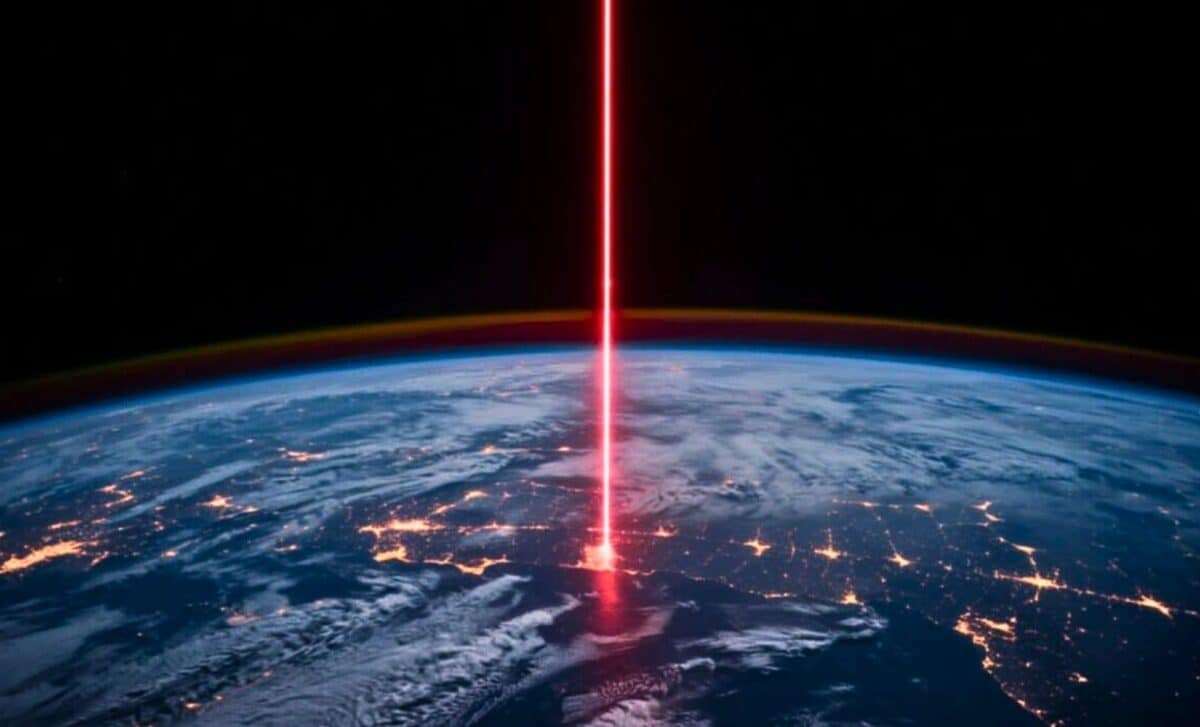
To put 8 billion light-years into perspective, this signal originated when our solar system was still forming, and complex life on Earth was billions of years in the future. The light we are now detecting embarked on its journey before the dinosaurs roamed the Earth. The universe was younger, and the objects within it, though potentially more active, would still be subject to the inverse square law of light, where brightness diminishes rapidly with distance. The 'mega-laser' quality of this emission – its narrowness and extreme luminosity – hints at a highly collimated beam, similar to a terrestrial laser pointer, but on an unimaginable cosmic scale. This isn't merely a bright star or a typical galaxy; it's something fundamentally different.
What Could Explain It?
- Exotic Astrophysical Source: Could it be an exceptionally powerful pulsar or an active galactic nucleus (AGN) viewed precisely along its relativistic jet? While AGNs are known to produce powerful jets, the consistent, un-fading nature of this specific signal over observed periods remains a puzzle, even for the most energetic blazars.
- Gravitational Lensing: Another strong contender is gravitational lensing, where the gravity of a massive foreground object (like a galaxy cluster) bends and magnifies the light from a background source. This could explain the enhanced brightness, but typically, lensing also distorts the image, creating multiple arcs or images. The 'razor-thin' quality of the signal would require an exceptionally rare and precise alignment, potentially involving microlensing by individual stars within a foreground galaxy.
- Unprecedented Masing Activity: 'Masers' (Microwave Amplification by Stimulated Emission of Radiation) are naturally occurring phenomena in space, akin to lasers, but at microwave frequencies. They are found in star-forming regions or around supermassive black holes. However, a maser of this immense power and reach, capable of producing a 'mega-laser' effect across 8 billion light-years, would represent an entirely new class of cosmic maser, orders of magnitude more powerful than any observed to date.
- New Physics: The most intriguing, albeit speculative, possibility is that this signal points to astrophysical phenomena or even fundamental physics that we currently do not comprehend. The universe has a habit of surprising us, and each unexplained anomaly pushes the boundaries of our knowledge.
Implications for Cosmology and Beyond
The discovery of this 'mega-laser' beam from the distant past is more than just an astronomical curiosity; it's a potential Rosetta Stone for understanding the universe's evolution. If it's a new type of energetic object, it could rewrite chapters on star formation, galaxy evolution, or even the life cycles of supermassive black holes in the early cosmos. If it's a unique lensing event, it offers an unprecedented opportunity to study the distribution of dark matter and foreground structures at extreme distances.
Moreover, such a distinct and powerful signal inevitably sparks discussions about the possibility of technosignatures. While astronomers are rigorously pursuing natural explanations, the sheer power and focused nature of the beam make it a compelling subject for further scrutiny. The scientific community's primary focus remains on natural astrophysical processes, but every truly anomalous signal stretches the imagination and reinforces the vastness of what we still don't know.
The Road Ahead: Unraveling the Mystery
The next steps involve intensive follow-up observations with MeerKAT and other telescopes across different wavelengths, hoping to glean more characteristics of the source. Precise localization, repeated measurements of its intensity and spectral properties, and searches for any associated objects will be crucial. This 'mega-laser' stands as a beacon of cosmic wonder, a compelling invitation for scientists to push the boundaries of current theories and potentially uncover an entirely new facet of the universe. Its refusal to fade out is not just a defiance of physics; it's a stubborn call to discover the secrets it holds, 8 billion light-years in the making.