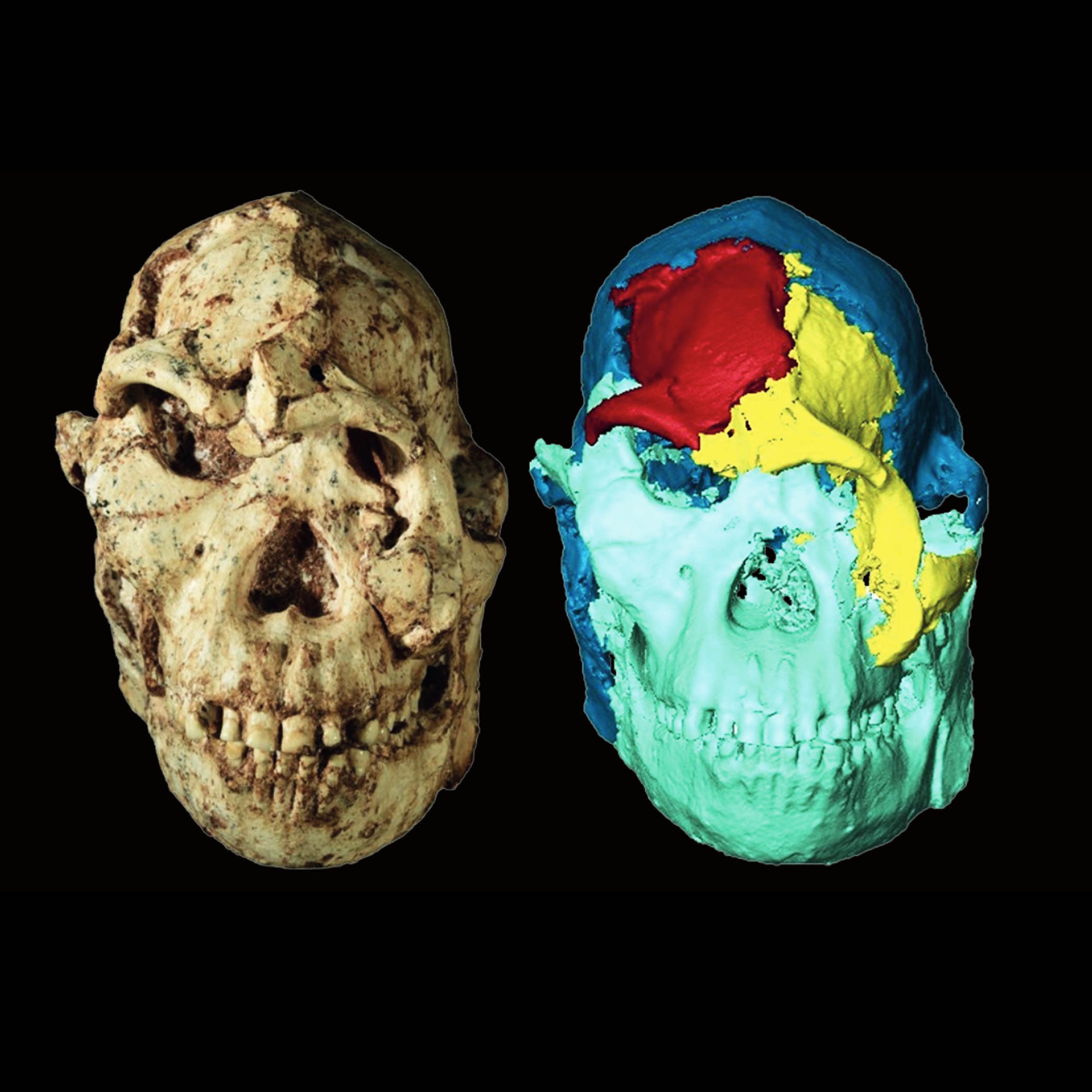
Beyond the Distortion: 'Little Foot's' Reconstructed Face Offers Unprecedented Insights into Early Human Evolution
For millions of years, the face of "Little Foot" lay hidden, not just by layers of rock and sediment, but by the very forces of time that preserved it. Now, a groundbreaking digital reconstruction has peeled back these distortions, offering humanity its clearest glimpse yet into the visage of a 3.67-million-year-old ancestor, and in doing so, is fundamentally reshaping our understanding of early human evolution across Africa.
The Discovery of an Unrivaled Ancestor
Discovered in the Sterkfontein Caves of South Africa, the fossil known as "Little Foot" (scientific name: Australopithecus prometheus) stands as one of the most complete early hominin skeletons ever unearthed. Its remarkable preservation, including an almost intact skull and skeletal elements, has made it an invaluable treasure for paleoanthropologists. However, the immense pressure of the earth over 3.67 million years had also warped and compressed its delicate facial structure, obscuring critical details that could inform our understanding of its life and lineage.
For decades, scientists have grappled with how to accurately interpret these ancient remains, often relying on comparative anatomy and educated guesses to infer original forms. The challenge was akin to piecing together a complex puzzle where many pieces were bent out of shape.
A Digital Resurrection: Unraveling Millennia of Distortion
The new reconstruction marks a significant leap forward, leveraging advanced digital imaging and computational analysis. Researchers meticulously scanned the fossilized remains, creating a high-resolution 3D model. Through sophisticated algorithms and anatomical expertise, they were able to virtually "undo" the distortions caused by millions of years underground. This process wasn't simply a matter of stretching and pulling; it involved complex biomechanical simulations and a deep understanding of hominin craniofacial anatomy to restore the skull to its probable original configuration.
This innovative methodology represents a paradigm shift in paleoanthropology. Rather than working with physically deformed specimens, scientists can now interact with a "virtually corrected" version, allowing for unprecedented accuracy in measurement and analysis. It's a testament to how technology is bridging the vast chasm of time, bringing our ancestors into clearer focus.
What 'Little Foot's' Face Reveals About Our Past
The newly reconstructed face of "Little Foot" is far more than just an aesthetic revelation; it's a trove of scientific data. The accurate restoration of its facial morphology provides crucial clues about its species' diet, sensory capabilities, and perhaps even social behaviors. For instance, the precise positioning of the eye sockets, the shape of the nasal cavity, and the structure of the jaw can offer insights into its visual acuity, sense of smell, and the types of food it could process.
More broadly, this clarity allows scientists to more accurately compare Australopithecus prometheus with other early hominin species, such as Australopithecus afarensis (Lucy) and Paranthropus robustus. These comparisons are vital for understanding the branching pathways of human evolution, helping to clarify which species are direct ancestors, which were evolutionary dead ends, and how various traits developed over time in different lineages across the African continent.
Reshaping the Evolutionary Narrative
The implications of this research are profound. By correcting the facial distortions, "Little Foot" now presents a more accurate anatomical profile, which may lead to a re-evaluation of its phylogenetic placement. Existing theories about the divergence of hominin groups, the timing of certain evolutionary adaptations, and even migration patterns might need recalibration based on these new insights. If "Little Foot's" true features differ significantly from previous assumptions, it could shift our understanding of the 'family tree' of early humans.
This project underscores the dynamic nature of scientific discovery. Our understanding of human origins is not static; it's a constantly evolving narrative, meticulously pieced together from fragmented clues, each new discovery and technological advancement adding another crucial chapter. "Little Foot's" corrected face reminds us that even the most studied fossils still hold secrets waiting to be unlocked.
The Future of Paleoanthropology: A Digital Frontier
The success of "Little Foot's" reconstruction paves the way for similar analyses of other significant but distorted fossils. This digital approach offers a non-invasive, highly precise method to bring ancient remains back to their original forms, virtually. It enables researchers worldwide to collaborate on these models, fostering a more interconnected and data-driven approach to understanding our deep past.
As technology continues to advance, we can anticipate even more detailed and accurate reconstructions, allowing us to not just see, but perhaps even simulate the lives of our ancient relatives with unprecedented clarity. The story of human evolution is far from complete, and "Little Foot's" new face is a powerful testament to the thrilling discoveries that still lie ahead.