Martian Gold Rush: Curiosity's Accidental Breakthrough Unearths a Yellow Enigma on the Red Planet
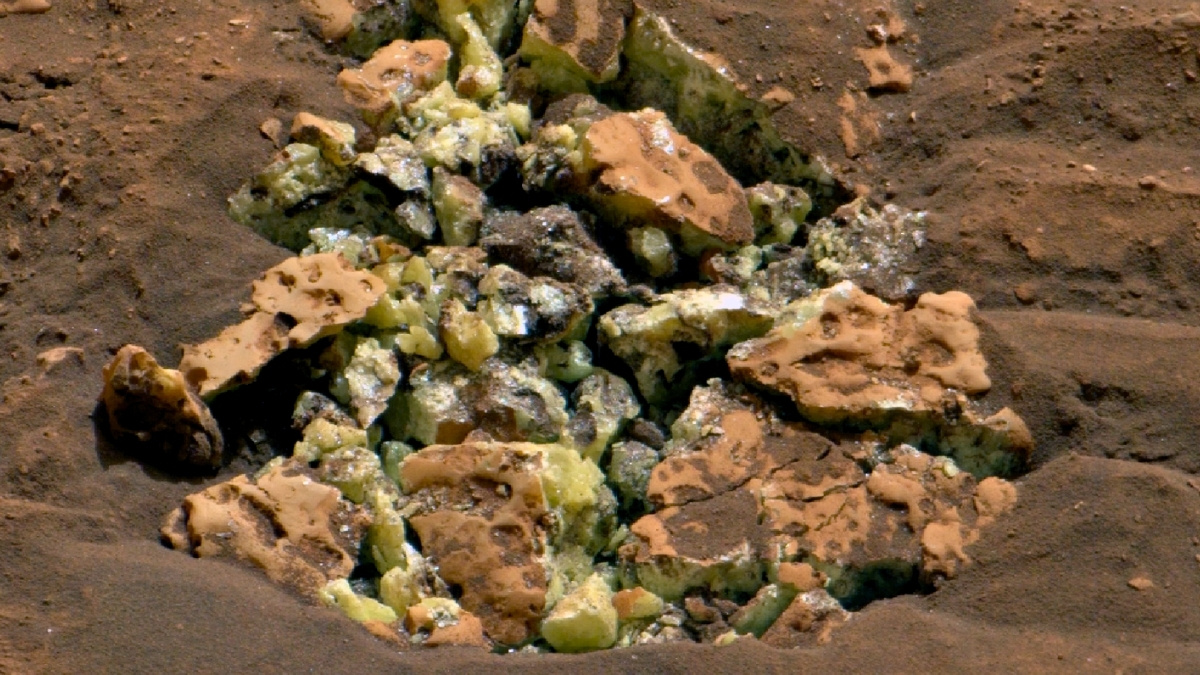
The Red Planet, often perceived as a desolate expanse of rust-colored dust and rock, continues to hold surprises that challenge our preconceived notions. In a truly serendipitous turn of events, NASA's Mars Science Laboratory rover, Curiosity, has once again proven that some of the most profound discoveries emerge not from meticulous planning, but from fortunate accidents. Its latest revelation: a vibrant, unexpected splash of yellow hidden within an otherwise unremarkable Martian rock, a find that could rewrite chapters of Martian geological history.
The Unforeseen Discovery: A Crack in the Routine
Curiosity, a robotic geologist weighing nearly a ton, has spent over a decade traversing the challenging terrains of Gale Crater, meticulously analyzing rocks and soil samples in its quest to understand Mars' past habitability. On this particular occasion, as the rover navigated its rugged path, its substantial 899-kilogram (1,982-pound) frame rolled over a seemingly ordinary rock. The pressure, perhaps just the right amount on a fragile specimen, caused the exterior to crack open, spilling forth a startling yellow material that immediately captured the attention of scientists back on Earth.
This wasn't a targeted drill, nor a deliberate abrasion. It was an accidental unveiling, a moment of geological candor that bypasses layers of Martian dust and weathering to expose something truly pristine and profoundly intriguing. The stark contrast between the dull, weathered exterior and the brilliant interior substance speaks volumes about the dynamic processes hidden beneath the Martian surface.
What is this 'Yellow Treasure'? Deciphering the Martian Hue
The immediate question echoing through mission control rooms and scientific forums is, of course: what exactly is this 'yellow treasure'? While definitive answers await more detailed spectroscopic and chemical analyses by Curiosity's sophisticated instruments, several compelling hypotheses emerge:
- Sulfur Compounds: Many yellow minerals on Earth are sulfur-bearing, such as jarosite, a hydrated iron sulfate. The presence of jarosite on Mars has previously been linked to past acidic water environments, hinting at a potentially more active hydrological past than we currently understand. If this new find is also sulfur-rich, it could indicate significant past hydrothermal activity or specific evaporitic conditions.
- Exotic Salts or Minerals: Mars' unique geological evolution, coupled with its distinct atmospheric and thermal conditions, could foster the formation of minerals not commonly found on Earth. This yellow material could be a novel Martian salt or mineral phase, offering new insights into the planet's geochemical pathways.
- Organic Molecules: While a less probable immediate identification for a vivid yellow mineral, the possibility of complex organic molecules cannot be entirely ruled out without comprehensive analysis. Certain organic compounds can exhibit various colors, and their discovery would carry immense astrobiological significance.
Curiosity's onboard Mastcam, ChemCam, and APXS instruments will be crucial in characterizing the elemental composition and mineralogy of this material. The data they collect will be instrumental in narrowing down the possibilities and revealing the true nature of this accidental find.
Broader Implications: Reshaping Our Martian Narrative
Beyond the immediate excitement, this discovery carries profound implications for our understanding of Mars:
- Geological Diversity: It reinforces the idea that Mars is far more geologically diverse and complex than its outwardly uniform appearance suggests. Subsurface processes and varied aqueous environments have likely left behind a rich tapestry of mineral deposits.
- Past Water Activity: If the yellow material is indeed a hydrous mineral, it provides further compelling evidence for the extensive presence of liquid water on Mars in its ancient past, and perhaps even subsurface pockets today. This is a cornerstone in the search for past or present life.
- Resource Potential: Understanding the mineral composition of Mars is vital for future human missions. Discoveries of specific elements or compounds could point to potential in-situ resource utilization (ISRU) opportunities, making future colonization more feasible.
- Guiding Future Exploration: Such unexpected finds often recalibrate scientific priorities. This discovery might influence future rover traverse plans or even the selection of landing sites for subsequent missions like the Mars Sample Return campaign, ensuring we target areas with high scientific payoff.
The Enduring Legacy of Serendipity
This 'Martian gold rush' reminds us that scientific exploration is as much about meticulous planning as it is about embracing the unexpected. Curiosity, designed to systematically explore and analyze, stumbled upon one of its most intriguing finds through an unforeseen interaction with its environment. It underscores the value of long-duration missions, allowing for prolonged exposure to a planet's myriad secrets and the chance encounters that can unravel its deepest mysteries.
As Curiosity now turns its full suite of scientific tools towards this newly exposed yellow enigma, the global scientific community holds its breath. What profound truths about Mars' past chemistry, geology, and perhaps even its potential for life, will this accidental crack reveal? The Red Planet continues to prove that even after decades of exploration, its most dazzling secrets often lie just beneath the surface, waiting for the right moment — or the right rover — to bring them to light.