Witnessing Cosmic Cataclysm: Astronomers Observe a Planetary Collision in Real-Time
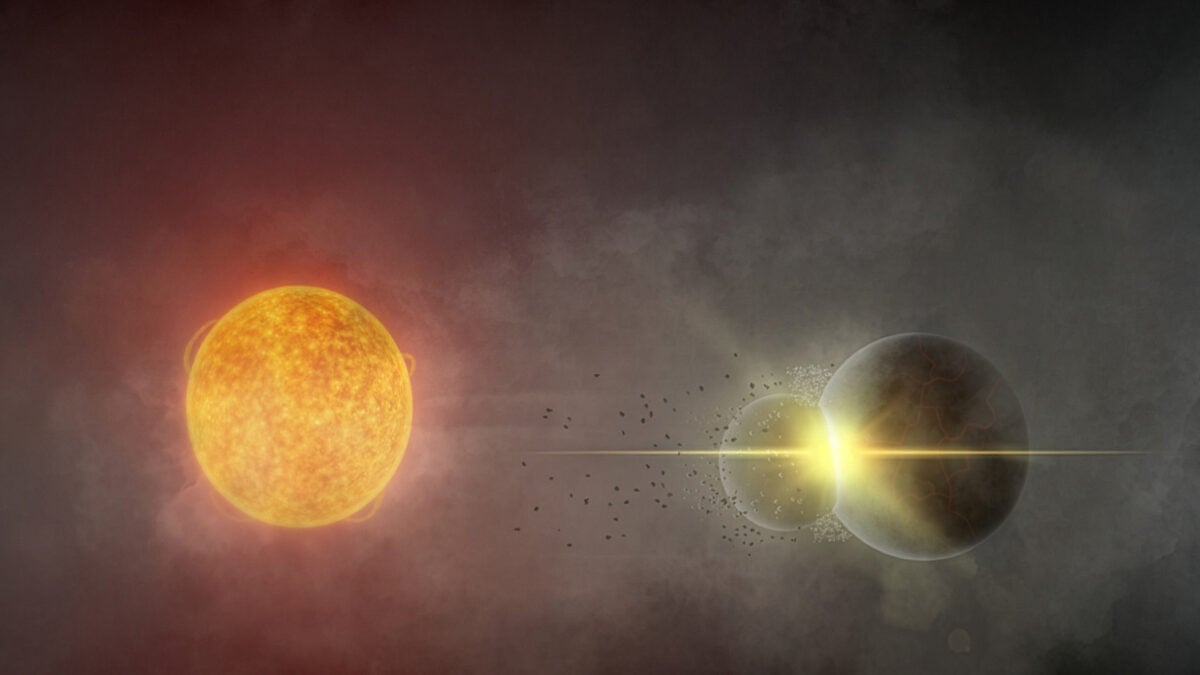
In a discovery that redefines our understanding of planetary evolution, astronomers have for the first time directly observed two exoplanets colliding around a nearby Sun-like star. The event, a cosmic catastrophe of monumental proportions, unfolded before the watchful eyes of researchers, providing an unprecedented glimpse into the violent processes that sculpt solar systems, including our own.
The Flickering Star and the Fiery Revelation
The story began with a seemingly ordinary star, remarkably similar to our Sun, whose light unexpectedly began to flicker and fade erratically. This erratic behavior, far from a subtle cosmic dance, hinted at a disturbance of incredible magnitude. It wasn't a dying star or a passing asteroid, but something far more dramatic: the catastrophic impact between two nascent worlds.
For billions of years, the theories of planet formation have posited such collisions as crucial architects of solar systems. Giant impacts are believed to be responsible for tilting planetary axes, stripping away atmospheres, and most famously, creating moons. Our own Moon is widely thought to have formed approximately 4.5 billion years ago from the debris ejected when a Mars-sized protoplanet, Theia, slammed into early Earth. Until now, this was a theory supported by geological evidence and sophisticated simulations, but never directly observed.
A Cosmic Crash Caught on Camera
The tell-tale signs of this monumental crash were picked up by advanced telescopes, which detected not only the star's sudden dimming but also a subsequent surge in infrared emissions. This infrared glow is precisely what scientists would expect from a colossal cloud of superheated dust and rock, vaporized and thrown into space by the force of impact. Imagine the energy released: untold quadrillions of joules, enough to melt and reshape entire worlds in an instant.
The implications are profound. This isn't just an abstract data point; it's a real-time validation of some of the most fundamental principles of astrophysics and planetary science. Witnessing such an event allows scientists to refine their models, test hypotheses about the composition and dynamics of young planetary systems, and gain critical insights into the chaotic early lives of stars and their burgeoning worlds.
The Echo of Creation: A New Moon or a Destined Destruction?
What does this collision mean for the star system involved? The immediate aftermath is a vast, swirling disk of incandescent debris. Over millions of years, this material could coalesce, forming new moons around the surviving planet, or perhaps even creating smaller, irregular bodies. Alternatively, if the impact was sufficiently energetic, it might have completely annihilated one or both planets, leaving behind nothing but a ring of rubble that will eventually dissipate or fall back into the star.
Scientists will now meticulously track this system, searching for clues in the evolving dust cloud. Spectroscopic analysis can reveal the composition of the shattered worlds, offering hints about their original formation and the raw materials available in that distant stellar nursery. Changes in the star's light curve, combined with infrared observations, will paint a dynamic picture of how quickly the debris disperses or aggregates.
Why This Observation Changes Everything
For decades, our understanding of planet formation has been largely built on indirect evidence: the composition of meteorites, the scarred surfaces of our solar system's planets and moons, and theoretical models run on supercomputers. This direct observation provides an invaluable anchor for these theories, transforming abstract calculations into tangible cosmic events.
It reinforces the idea that the universe is a violent, dynamic place, where creation and destruction are two sides of the same cosmic coin. While such events are rare on human timescales, they are fundamental to the grand sweep of cosmic history. This discovery isn't just about two distant planets; it's about better understanding the violent birth of our own Earth and Moon, and by extension, the conditions necessary for life to emerge anywhere in the cosmos.
Looking to the Future
The identification of this collision marks a new era in exoplanetary science. With ever-improving telescopic capabilities, astronomers are now poised to potentially witness more such events, building a statistical understanding of their frequency and characteristics. Each observation will be a Rosetta Stone, helping us decode the universal language of planet formation and evolution.
The universe, it seems, is not merely a static backdrop for our existence, but an active, unfolding drama. And thanks to dedicated scientists and cutting-edge technology, NovaPress readers can now witness the spectacle of creation and destruction playing out light-years away.