The Unprecedented Leap: How NVIDIA's AI and RTX Are Revolutionizing Path Tracing by 1,000,000x
NovaPress Staff Writer | March 15, 2026
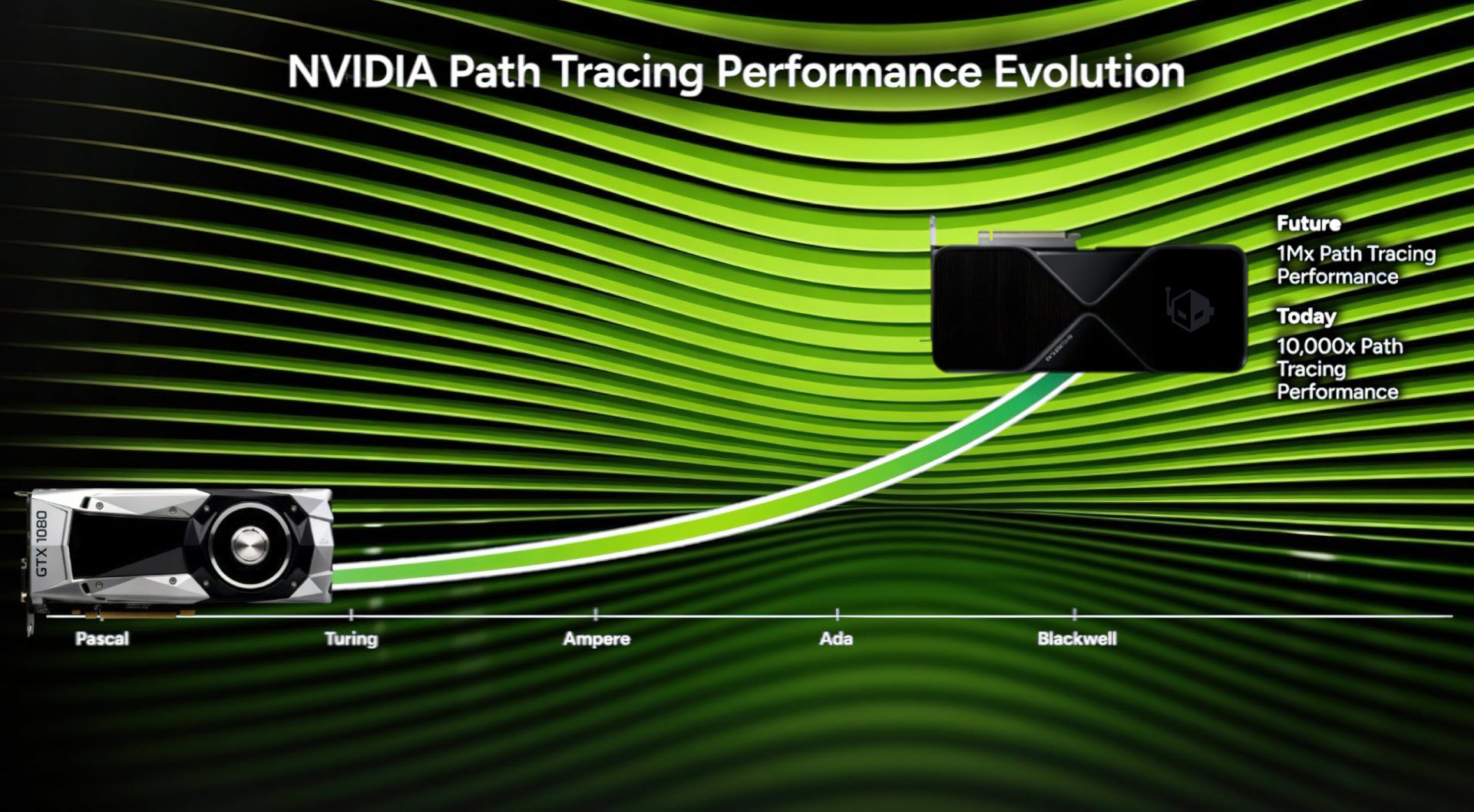
At the much-anticipated Game Developers Conference (GDC) 2026, the tech world was set ablaze by an announcement from NVIDIA that promises to reshape the very fabric of digital realism. John Spitzer, NVIDIA's esteemed VP of Developer Technology, unveiled a vision of future GPUs capable of delivering an astonishing 1,000,000x leap in path tracing performance. This isn't merely an incremental upgrade; it's a quantum jump, signaling a new era for gaming, professional visualization, and the metaverse, fundamentally driven by an intricate dance between advanced RTX hardware and sophisticated AI.
Beyond Ray Tracing: Understanding the Path Tracing Paradigm Shift
For years, ray tracing has been the Holy Grail of real-time graphics, mimicking the physical behavior of light to render incredibly realistic scenes. It simulates light rays from a camera bouncing off objects, capturing reflections, refractions, and shadows with unprecedented accuracy. Path tracing takes this concept to its ultimate conclusion. Instead of sampling a limited number of light paths, it simulates millions or even billions of paths that light takes through a scene. The result is photorealism indistinguishable from reality, capturing subtle nuances like global illumination, diffuse inter-reflections, and complex caustic effects that traditional ray tracing often struggles with.
Historically, the computational demands of true path tracing have relegated it to offline rendering for cinematic production and architectural visualization – processes that can take hours or even days for a single frame. The idea of achieving this level of fidelity in real-time, let alone at playable frame rates, seemed a distant dream, constrained by the perceived limitations of 'Moore's Law is Dead' rhetoric.
The Million-Fold Breakthrough: How AI and RTX Intertwine
NVIDIA's monumental claim hinges on the synergistic evolution of its RTX architecture and revolutionary AI advancements. The '1,000,000x' figure isn't just about raw shader core throughput; it represents a comprehensive overhaul of how light is simulated and rendered:
- Next-Gen RT Cores: Future RTX GPUs will feature dramatically enhanced Ray Tracing Cores, optimized to handle the immense geometric complexity and ray traversal demands of path tracing more efficiently than ever before. These aren't just faster; they're smarter, designed to accelerate the multi-bounce calculations inherent in path tracing.
- Tensor Core & AI Acceleration: This is where the magic truly happens. NVIDIA's Tensor Cores, previously instrumental in DLSS (Deep Learning Super Sampling), are being leveraged for entirely new applications. AI models are now capable of 'denoising' path-traced images generated with far fewer samples, effectively reconstructing a photorealistic image from incomplete data. This drastically reduces the number of light paths that need to be explicitly calculated by the hardware, presenting an immense efficiency gain.
- Neural Radiance Fields (NeRFs) and Beyond: The underlying AI could also be incorporating concepts from neural rendering techniques like NeRFs, allowing for incredibly complex light transport to be learned and rendered by neural networks rather than brute-force computation. This could mean dynamic light bounce effects, global illumination, and even subtle subsurface scattering are computed or enhanced by AI in real-time.
- Memory Bandwidth and Latency: While not explicitly detailed, such a leap would undoubtedly require significant innovations in memory bandwidth, cache architectures, and latency reduction to feed the AI and RT cores with the necessary data at unprecedented speeds.
Implications for Gaming and Beyond
The implications of a 1,000,000x path tracing leap are nothing short of transformative:
- Unrivaled Gaming Realism: Imagine games where every pixel reacts to light exactly as it would in the real world – perfect reflections, soft shadows that accurately diffuse, and environments where light truly illuminates and colors interact naturally. This paves the way for a level of immersion previously unimaginable, blurring the lines between virtual and reality.
- Metaverse Foundations: For the burgeoning metaverse, photorealistic and dynamic environments are crucial. NVIDIA's breakthrough could provide the rendering backbone for truly believable persistent virtual worlds, fostering deeper engagement and more meaningful digital interactions.
- Professional Visualization & Simulation: Architects can walk through perfectly lit digital buildings, engineers can visualize prototypes with cinematic accuracy, and filmmakers can pre-visualize scenes with real-time, production-quality lighting. This accelerates workflows and reduces iteration times across industries.
- Democratization of Visual Fidelity: While initial adoption will likely be at the high-end, the underlying technologies will undoubtedly filter down, making higher levels of graphical fidelity accessible to a broader range of hardware over time, much like DLSS did for earlier generations of ray tracing.
The Road Ahead
NVIDIA's announcement at GDC 2026 isn't just a promise; it's a bold declaration of intent. While the full technical details and release timelines for these future GPUs remain under wraps, the message is clear: the future of real-time graphics is path-traced, and it will be powered by an incredible synergy of dedicated hardware and intelligent AI. As the industry grapples with the 'end' of traditional silicon scaling, NVIDIA demonstrates that innovation thrives through architectural brilliance and the transformative power of artificial intelligence. Get ready for a visual revolution unlike anything we've ever seen.