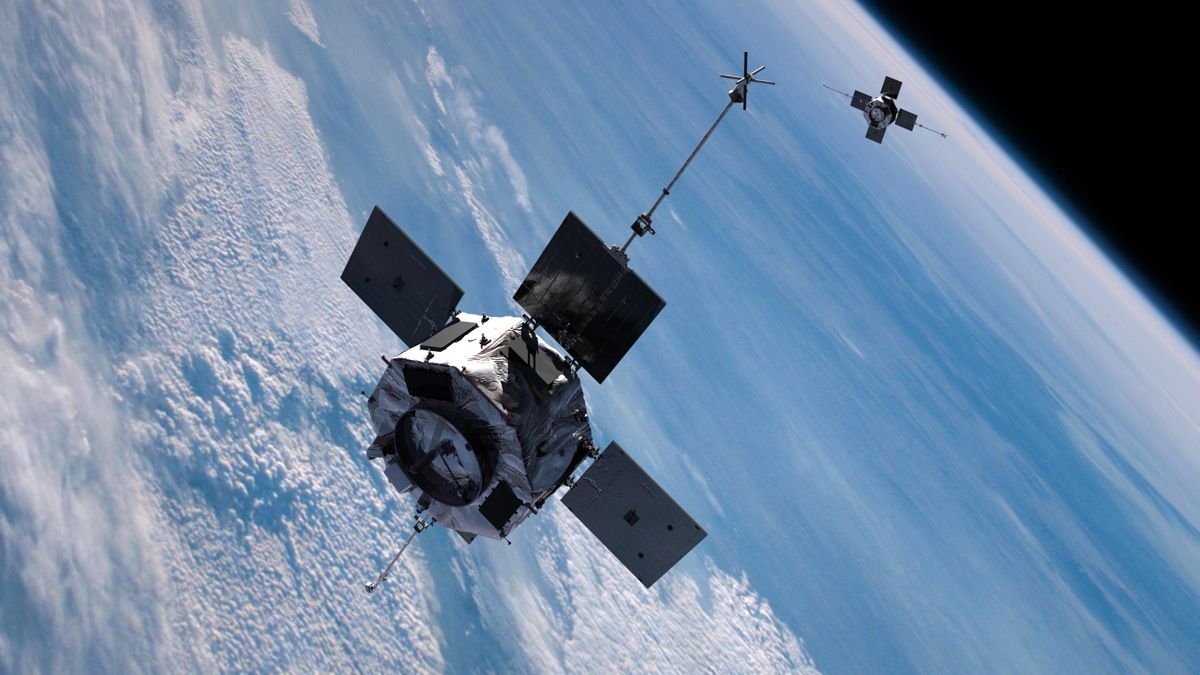
Celestial Roulette: When a 1,300-Pound NASA Satellite Falls, What Does It Mean for Earth's Orbit?
In a stark reminder of humanity's growing footprint beyond Earth, a 1,300-pound NASA satellite completed its fiery descent back to our planet last Wednesday, re-entering the atmosphere over the eastern Pacific Ocean at 6:37 a.m. EDT. While largely uneventful for those on the ground, the uncontrolled re-entry of such a significant piece of space hardware sparks critical questions about orbital sustainability, space debris, and the future of our celestial endeavors.
The Mechanics of a Fiery Return
Unlike controlled deorbiting procedures, where spacecraft are intentionally guided to specific, unpopulated regions (like the "spacecraft graveyard" in the South Pacific), this satellite's return was a consequence of orbital decay. Over its operational lifespan, and after its mission concluded, the satellite gradually lost altitude due to atmospheric drag – a subtle yet constant braking force even in the vacuum of low-Earth orbit. Eventually, gravity wins, pulling the object into denser atmospheric layers where friction generates immense heat, causing most of the satellite to burn up. What survives typically consists of heat-resistant components, often fragments of tanks or structural elements.
A Wake-Up Call: The Looming Crisis of Space Debris
While the recent re-entry thankfully posed no threat to populated areas, it highlights a much larger, increasingly urgent problem: space debris. The European Space Agency estimates there are over 36,500 pieces of space junk larger than 10 cm, and millions more smaller fragments, all hurtling around Earth at speeds of tens of thousands of kilometers per hour. These objects, ranging from defunct satellites and spent rocket stages to tiny paint flakes, pose a catastrophic threat to operational satellites, the International Space Station, and future human spaceflight missions.
Each collision, even with a small piece of debris, can create thousands of new fragments, triggering a cascade known as the Kessler Syndrome – a theoretical scenario where the density of objects in low Earth orbit is so high that collisions between objects create an exponentially increasing amount of new debris, making space activities impossible for generations.
Navigating the Future: Policy, Technology, and Responsibility
Recognizing the escalating risk, international bodies and space agencies are scrambling to implement solutions. The "25-year rule" for deorbiting, which mandates that satellites must be removed from orbit within 25 years of their mission's end, is a crucial guideline. However, compliance varies, and older satellites like the recently re-entered one often predate such regulations or lack the necessary propulsion systems for controlled deorbiting.
Technological innovations are also emerging. Companies are exploring active debris removal (ADR) techniques, from robotic arms that capture and deorbit defunct satellites to harpoons, nets, and even lasers designed to push debris into lower orbits where they can burn up. Furthermore, new satellite designs prioritize "design for demise," ensuring that spacecraft components are made from materials that fully disintegrate upon atmospheric re-entry.
Beyond Earth's Atmosphere: A Shared Frontier
The re-entry of a 1,300-pound NASA satellite serves as a powerful metaphor for our collective responsibility in the cosmos. As we venture further into space, establishing constellations of thousands of satellites and planning missions to the Moon and Mars, the careful stewardship of Earth's orbital environment becomes paramount. The skies above are not limitless, and without concerted global effort, the very highways we use to explore the universe could become impassable. The incident over the Pacific is a timely reminder that while gravity may clean up some of our mess, proactive and sustainable space practices are the only way to ensure humanity's continued access to this shared frontier.