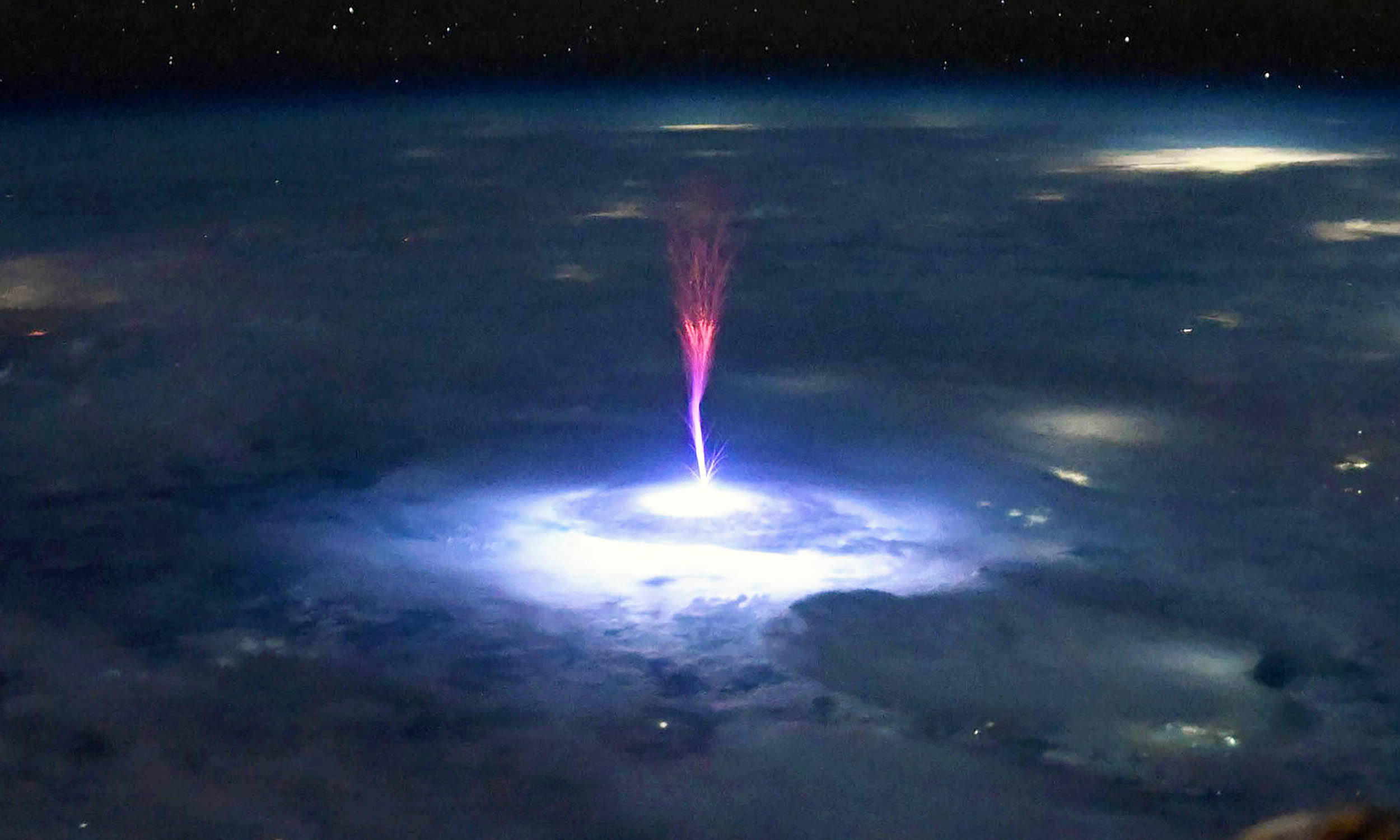
Beyond the Thunder: NASA's ISS Captures Electric Fireworks High Above Earth, Reshaping Our View of Atmospheric Dynamics
For millennia, humanity has looked to the skies, mesmerized by the raw power of thunderstorms. The familiar crack of thunder and flash of lightning are staples of our terrestrial experience. Yet, high above these tempestuous events, in the thin, ethereal layers of Earth's atmosphere, another, far more spectacular electrical drama unfolds – one that astronauts aboard the International Space Station (ISS) are now capturing with unprecedented clarity, revealing phenomena that could profoundly impact radio communications, climate models, and even astronaut safety.
Unveiling the Upper Atmosphere's Secret Light Show
From their orbital vantage point, ISS scientists are witnessing what can only be described as 'electric fireworks.' These aren't your typical lightning bolts; they are fleeting, brilliantly colorful events erupting in the mesosphere and stratosphere, layers stretching from roughly 20 to 90 kilometers (12 to 55 miles) above Earth's surface. These Transient Luminous Events (TLEs) include spectacular phenomena like sprites, elves, and blue jets, each with its own unique visual signature and underlying physics.
Sprites, perhaps the most visually striking, are massive, fleeting flashes of red light that can extend vertically for tens of kilometers, often resembling giant jellyfish or carrots. They are typically triggered by powerful positive lightning strikes within thunderstorms below. Elves, by contrast, are rapidly expanding rings of light in the ionosphere, caused by electromagnetic pulses from lightning. Blue jets, as their name suggests, are cone-shaped beams of blue light that shoot upwards from the top of thunderclouds, reaching altitudes of up to 50 kilometers.
The Science Behind the Spectacle
These high-altitude electrical discharges are not just beautiful; they are crucial indicators of energy transfer between the lower atmosphere and the near-space environment. Unlike conventional lightning, which occurs within charged storm clouds, TLEs are sparked by the electrostatic fields above powerful thunderstorms. When a particularly strong lightning bolt discharges a significant amount of charge, it can create an intense electric field that accelerates electrons in the rarefied air above, causing them to collide with air molecules and emit light.
Beyond visual TLEs, astronauts are also documenting Terrestrial Gamma-ray Flashes (TGFs) – millisecond bursts of gamma rays and positrons produced in the upper atmosphere, often linked to the most intense lightning activity. These phenomena represent the most energetic electrical events known on Earth, carrying profound implications for our understanding of fundamental atmospheric and particle physics.
Far-Reaching Implications: Radio, Climate, and Safety
The data being meticulously collected by NASA from the ISS is proving invaluable, shedding light on how these extraordinary events impact several critical areas:
- Radio Communications: TLEs and TGFs occur in the same atmospheric layers through which radio signals, particularly those used for long-distance communication and GPS, travel. Their intense electromagnetic disturbances can interfere with these signals, leading to disruptions or degradation. Understanding their frequency and intensity is vital for improving communication reliability.
- Climate Models: The energy transfer associated with these high-altitude events, including the ionization of atmospheric gases and the production of nitrogen oxides, can influence the chemical composition of the upper atmosphere. This has implications for ozone depletion and the radiative balance of the planet, requiring their inclusion in sophisticated climate models for more accurate predictions.
- Aviation and Space Safety: While infrequent, highly energetic events like TGFs pose potential radiation risks to high-altitude aircraft and spacecraft. Comprehensive mapping and prediction of these phenomena are crucial for devising safer flight paths and orbital trajectories, protecting both crew and sensitive equipment.
A New Era of Atmospheric Science
The sustained observation capabilities of the ISS, equipped with specialized cameras and sensors, have ushered in a new era for atmospheric science. Astronauts, often capturing these events during specific orbital passes over active storm regions, provide a unique, real-time perspective that ground-based observatories cannot fully replicate due to atmospheric attenuation and curvature.
The NovaPress Insight:
This continuous stream of data from the ISS is not merely expanding our scientific catalog; it is fundamentally altering our understanding of Earth's electrical environment. By unraveling the mysteries of these high-altitude 'electric fireworks,' scientists are better equipped to predict their impacts on our technological infrastructure and refine our global climate models, ultimately benefiting life on Earth in ways we are only just beginning to grasp.
As NASA continues its mission, the dazzling light shows witnessed by astronauts serve as a potent reminder of the dynamic, often unseen forces at play within our own planet's atmosphere. These insights are not just about celestial beauty; they are about understanding the intricate dance of energy that shapes our world, from the ionosphere down to the ground we stand on, and safeguarding our future in an increasingly interconnected and space-faring era.