Cosmic Guardians' Swan Song: Unpacking the Return of NASA's Van Allen Probe and Its Legacy
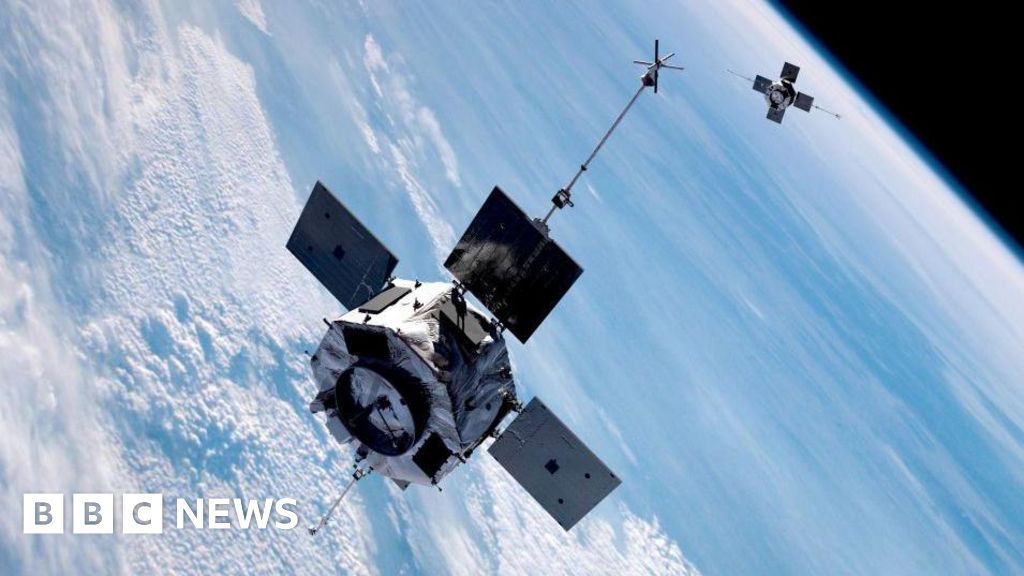
In a testament to the cyclical nature of space exploration, a 1,300-pound sentinel that once orbited Earth, diligently studying our planet's invisible shields, is making its final descent. NASA's Van Allen Probe, a workhorse of scientific discovery, is scheduled to re-enter Earth's atmosphere, largely burning up in a fiery spectacle. While NASA assures a "low risk" of surviving components impacting populated areas, the event marks the conclusion of a profoundly successful mission and offers a moment to reflect on the vital role these probes played in understanding the cosmic forces that shape our planet.
The Unseen Protectors: Earth's Van Allen Belts
At the heart of the Van Allen Probes' mission lies the study of a phenomenon crucial for all life on Earth: the Van Allen belts. These two concentric rings of energetic charged particles, held in place by Earth's magnetic field, act as our planet's natural, formidable shield. They deflect and trap vast quantities of harmful cosmic radiation, streaming solar wind, and the energetic particles unleashed during powerful solar storms. Without these belts, our planet would be constantly bombarded by radiation capable of causing severe harm to humans and crippling advanced technology, from satellites to power grids.
For decades, scientists knew of their existence, but the intricate dynamics of these belts remained a mystery. How do they form? How do they change in response to solar activity? And crucially, how do they protect us?
A Mission of Discovery: Unlocking the Belts' Secrets
Launched in 2012, the Van Allen Probes (originally known as the Radiation Belt Storm Probes) were designed to provide unprecedented insights into the behavior of these dynamic regions. Comprising two identical spacecraft, they orbited through the belts themselves, gathering data on the particles, fields, and waves that govern their complex environment. Over their seven-year operational lifespan, the probes delivered a wealth of information, revealing unexpected phenomena such as the existence of a third, temporary radiation belt and the mechanisms by which particles are accelerated to relativistic speeds.
Their findings have revolutionized our understanding of space weather – the conditions in space that can affect Earth and its technological systems. This knowledge is not merely academic; it has direct implications for the safety of astronauts, the design of more resilient satellites, and the mitigation of risks to ground-based infrastructure susceptible to geomagnetic storms.
The Controlled Descent: A Responsible End
Having exhausted their fuel and completed their primary mission in 2019, the probes were carefully maneuvered into a trajectory that would ensure their eventual re-entry. This controlled deorbiting is a critical aspect of responsible space stewardship, minimizing the creation of dangerous space debris. While much of the 1,300-pound spacecraft is expected to disintegrate due to the intense heat generated by atmospheric friction, NASA's careful planning and trajectory analysis ensure that any surviving fragments pose only a negligible risk. This thoughtful approach underscores a growing commitment within the space community to manage the orbital environment for future generations.
Legacy and Future Implications for Earth's Protection
The legacy of the Van Allen Probes extends far beyond their re-entry. The data they collected continues to be analyzed, yielding new discoveries and refining our models of the near-Earth space environment. This deeper understanding directly informs efforts to protect our increasingly technology-dependent society from the whims of the Sun. From enhancing the resilience of GPS and communication satellites to developing better early warning systems for geomagnetic storms, the insights gained from these probes are indispensable.
As humanity ventures further into space, the lessons learned from the Van Allen Probes will be critical in designing safer habitats and spacecraft for long-duration missions. They remind us that even in the vastness of space, our planet is enveloped by dynamic forces that we must strive to comprehend and respect. The fiery end of this single probe is not an ending to discovery, but a powerful punctuation mark on a chapter of profound scientific achievement, paving the way for the next generation of cosmic guardians.