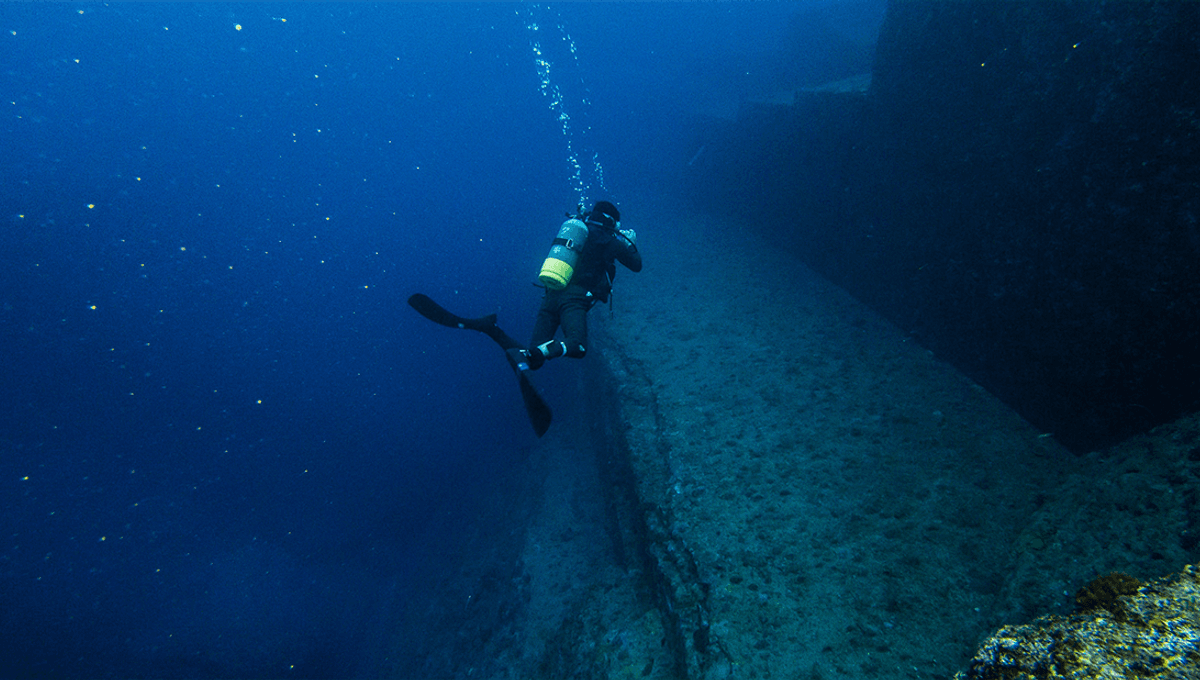
In 1986, a routine dive off the coast of Yonaguni, Japan's westernmost island, turned into a moment of profound discovery that would captivate the world and spark a decades-long debate. Kihachiro Aratake, a local diver, stumbled upon colossal, angular structures lying 25 meters beneath the ocean's surface. What he saw defied easy explanation: what appeared to be stepped terraces, straight edges, and massive blocks forming what many quickly dubbed a 'lost city' or 'Japan's Atlantis'. Since then, the Yonaguni Monument has become a focal point for archaeologists, geologists, and enthusiasts alike, each seeking to unravel its enigmatic origins.
The Initial Discovery and the Allure of a Lost Civilization
Aratake’s initial sighting quickly drew attention, not least because of the structures' seemingly artificial regularity. Divers and researchers, notably Professor Masaaki Kimura from the University of the Ryukyus, began extensive explorations. Kimura, a marine geologist, became one of the most vocal proponents of the theory that the monument was a man-made edifice—a submerged city dating back perhaps 10,000 years, predating known human building capacities in the region by millennia. He pointed to what he interpreted as roads, altars, staircases, and even carvings resembling animals and human faces, suggesting a sophisticated prehistoric civilization. The monumental scale of the formations, including a main pyramidal structure estimated to be 150 meters long and 25 meters high, certainly lent weight to the idea of an ancient, advanced society.
Arguments for a Natural Origin: The Geologist's Perspective
Despite the compelling arguments for human intervention, a substantial portion of the scientific community, particularly geologists, has leaned heavily towards a natural explanation. Leading this perspective are scientists like Dr. Robert Schoch, a professor of natural sciences at Boston University, and Professor Patrick D. Nunn, an expert in Pacific islands' geomorphology. They argue that the perceived architectural features—the flat terraces, sharp angles, and geometric shapes—are, in fact, classic examples of natural geological processes acting upon sandstone formations.
The specific geological characteristics of the Yonaguni area provide strong evidence. The monument is primarily composed of sandstone and mudstone that are prone to vertical and horizontal jointing. This natural fracturing, combined with millennia of erosion by ocean currents, tidal forces, and seismic activity (the region is highly tectonically active), can create incredibly regular and angular structures that mimic human craftsmanship. Schoch highlights features like 'bedding planes' (natural horizontal layers in sedimentary rock) and 'jointing' (vertical fractures) that, when exposed to weathering, can produce perfectly straight lines and right angles. What appears to be a 'staircase' could merely be naturally eroded bedding planes, and 'carvings' might be pareidolia—the human tendency to see familiar patterns in random data.
Contextualizing the Mystery: Science vs. Speculation
The Yonaguni Monument is not unique in its ability to spark debates between natural and artificial origins. Other underwater formations, such as the Bimini Road in the Bahamas, have similarly fueled theories of lost continents like Atlantis. In almost all such cases, rigorous scientific investigation has eventually attributed the features to natural geological processes. The human desire to uncover lost civilizations is powerful, often leading to interpretations that favor the romantic over the empirical.
For Yonaguni, the absence of clear archaeological evidence—such as tools, pottery, or definitive carvings that unequivocally require human agency—further weakens the man-made hypothesis. While some 'artifacts' have been reported, they often lack contextual provenance or have been reinterpreted as natural formations. The geological explanations, conversely, align with well-understood processes observable in similar rock types globally.
Future Implications: Preserving a Natural Wonder
Ultimately, the prevailing scientific consensus points to the Yonaguni Monument as a magnificent natural formation, a testament to the Earth's sculpting power. This doesn't diminish its wonder or its capacity to inspire. Instead, it offers a new lens through which to appreciate the planet's dynamic geological history. The monument serves as a living laboratory for understanding submarine geomorphology and the interplay of tectonic forces and erosion.
While the dream of a lost civilization beneath the waves remains a captivating narrative, the true marvel of Yonaguni might be found in its capacity to challenge our perceptions and remind us that nature's artistry can be as intricate and awe-inspiring as any human creation. It underscores the importance of critical thinking and scientific inquiry in distinguishing fact from fascinating speculation, even when the truth is less sensational than the myth.