Beneath the Earth's Skin: Unveiling the Deadly Grandeur of Mexico's Cave of Crystals
Deep within the rugged Sierra de Naica mountain range in Chihuahua, Mexico, lies a geological marvel that defies imagination: the Cave of Crystals. Buried a staggering 300 metres underground, this subterranean cathedral is not only home to the largest natural crystals ever discovered but also presents one of the most hostile environments on Earth, a testament to our planet's hidden power and beauty.
A Glimpse into Earth's Ancient Heart
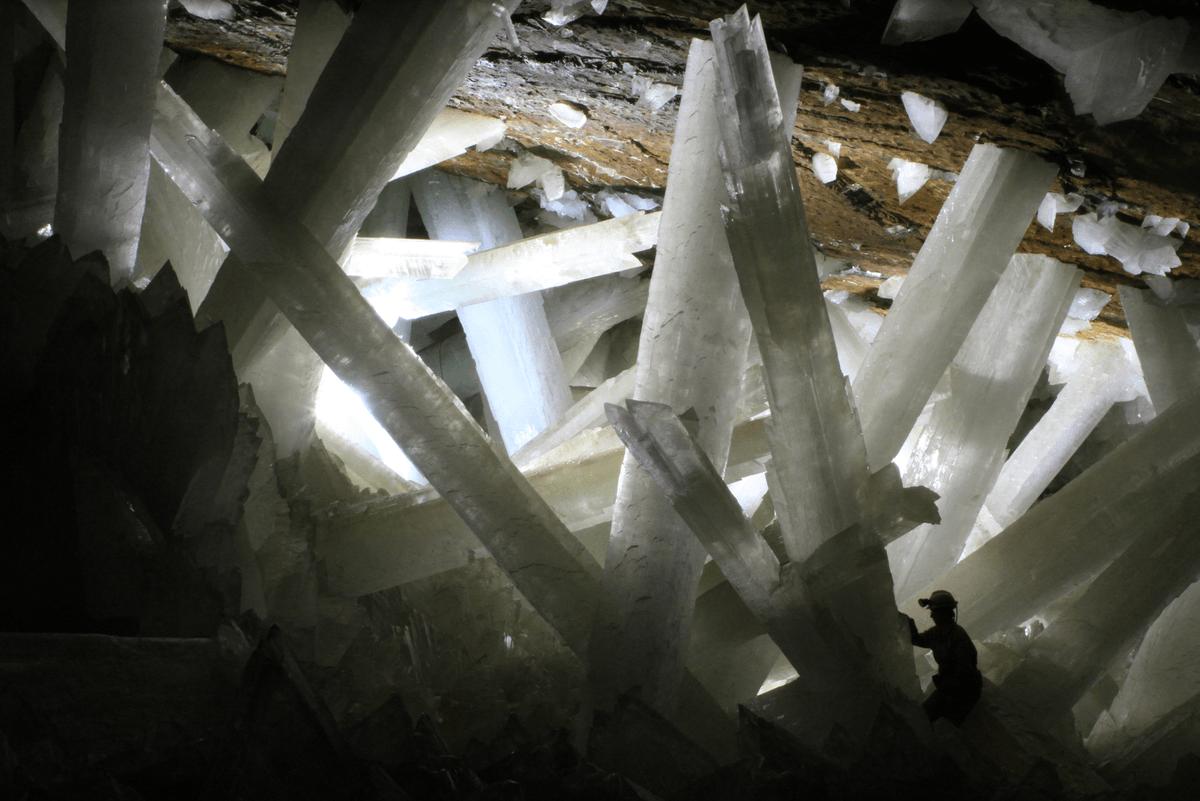
Discovered accidentally in 2000 by miners drilling for lead and silver, the Cave of Crystals (or Cueva de los Cristales) opened a window into an otherworldly realm previously unseen by human eyes. The cave's defining feature is its colossal gypsum crystals, some stretching an astonishing 11 metres long and weighing up to 55 tonnes. These translucent, sword-like formations jut out from the walls and floor, creating a landscape that feels more alien planet than terrestrial. Imagine a world where you could walk on crystals taller than a two-story building – here, that's a reality.
The Forging of Giants: A Geological Masterpiece
The existence of such immense crystals is a direct result of a unique geological cocktail. Beneath the Naica mine, a magma chamber lies deep below, heating subterranean water. This mineral-rich, super-saturated water, loaded with gypsum, percolated through faults and filled the cave chamber. For hundreds of thousands of years, perhaps even a million, these waters remained at a stable, elevated temperature (around 50-58°C or 122-136°F). This consistent thermal environment allowed microscopic anhydrite crystals to dissolve and recrystallize as gypsum, slowly growing into the colossal structures we see today. The process was painstakingly slow, allowing the crystals to achieve their incredible purity and size without interruption.
A Deadly Beauty: Navigating the Extremes
While undeniably beautiful, the Cave of Crystals is a deathtrap for the unprepared. The ambient air temperature hovers around 50°C (122°F), combined with an oppressive 90% to 100% humidity. This creates an environment where the human body cannot cool itself through perspiration, leading to rapid heatstroke and eventual organ failure. Without proper protective gear – specialized cooling suits and breathable air systems – a person can survive barely 10-15 minutes inside. Even with state-of-the-art equipment, exploration is limited to short, arduous stints. This extreme hostility safeguards the cave, making it one of the least disturbed natural wonders.
Scientific Goldmine and Astrobiological Frontier
Beyond its visual spectacle, the Cave of Crystals is a priceless scientific laboratory. Researchers have found ancient microorganisms trapped within pockets of fluid inside the crystals, some potentially millions of years old. These extremophiles, dormant for eons, offer unparalleled insights into the tenacity of life and how it can adapt to and survive in seemingly impossible conditions. This research has profound implications for astrobiology, helping us understand the potential for life on other planets or moons with similarly harsh environments. The cave also provides a unique opportunity to study the kinetics of crystal growth on a massive scale and understand Earth's geological history.
Preservation and the Future
The future of the Cave of Crystals is intertwined with the Naica mine's operations. For the cave to remain accessible and its crystals preserved, the mine's pumping systems must continuously remove water that would otherwise submerge the chamber. Should mining operations cease and the pumps be turned off, the cave would revert to its natural flooded state, once again protecting its treasures beneath the water. While this would make further human exploration impossible, it would also ensure the long-term preservation of this delicate ecosystem and its colossal crystals from external interference. The scientific community faces the ongoing challenge of extracting knowledge from this unique site while minimizing its footprint on one of Earth's most precious and fragile geological wonders.