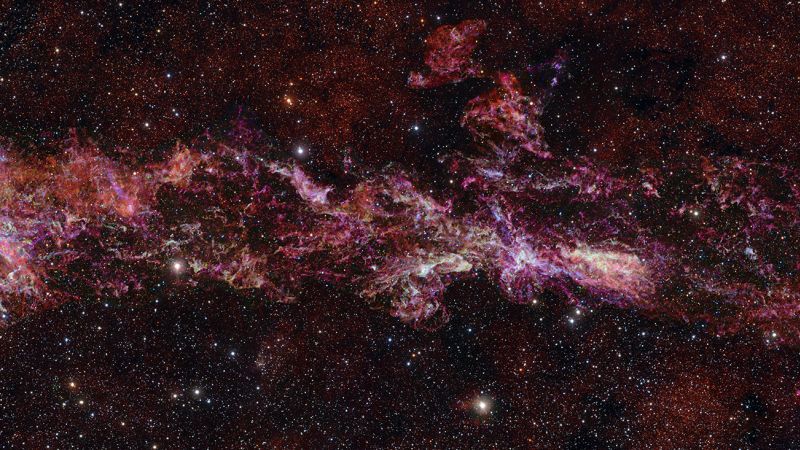
Unveiling the Cosmic Cradle: How a New Milky Way Map is Rewriting Our Understanding of Star Birth
By NovaPress Editorial Team | October 26, 2023
For centuries, humanity has gazed upon the night sky, captivated by the twinkling lights that dot the vast cosmic expanse. Each star, a distant sun, represents a complex story of birth, life, and death. Now, thanks to groundbreaking work by an international team of astronomers, we are closer than ever to understanding the very genesis of these celestial behemoths, and in turn, the origins of our own solar system and planet. A new, high-resolution map of the cold gas residing at the heart of the Milky Way has emerged, offering an unprecedented glimpse into the raw material from which stars and planets are forged.
The Heart of the Galaxy: A Stellar Nursery
The center of our Milky Way galaxy is not merely a dense cluster of stars; it is a dynamic, turbulent region brimming with the ingredients for cosmic creation. It's here, within vast clouds of gas and dust, that new stars are continuously being born. However, peering into this galactic core has always been a formidable challenge due to the immense distances and the obscuring interstellar dust that blocks visible light. Previous maps provided glimpses, but none have offered the comprehensive detail now available.
The latest achievement lies in mapping the 'cold gas' – primarily molecular hydrogen, laced with other elements – which constitutes the primary building block for stars. Unlike the hotter, more energetic gas, cold molecular gas is dense enough to collapse under its own gravity, initiating the process of star formation. The intricate details revealed by this new map expose filamentary structures, dense clumps, and turbulent eddies, each playing a crucial role in the lifecycle of these stellar nurseries.
Unlocking the Secrets of Stellar Genesis
This isn't just a pretty picture; it's a treasure trove of data that promises to revolutionize our understanding of astrophysical processes. By mapping the distribution, density, and velocity of this cold gas with unparalleled precision, astronomers can now test long-standing theories about star formation. How do these massive gas clouds collapse? What triggers the formation of multiple stars within a single cloud? How do magnetic fields and turbulence influence the process?
For instance, the map allows researchers to identify regions where gas is accumulating at critical densities, signaling imminent star birth. It also provides clues about the 'feedback' mechanisms – how newly formed massive stars, through their intense radiation and powerful stellar winds, can either trigger further star formation in adjacent regions or disperse surrounding gas, halting the process. Understanding these intricate balances is key to comprehending the overall evolution of galaxies.
From Cosmic Dust to Planetary Systems
The implications extend far beyond just stars. Where stars are born, planets often follow. The same cold gas and dust that coalesce to form a star also give rise to the protoplanetary disks from which planets are born. By understanding the initial conditions of these stellar nurseries, scientists can gain deeper insights into the prevalence and diversity of planetary systems, including our own. This map could help answer fundamental questions like: What kind of environments are most conducive to the formation of Earth-like planets? How common are the raw materials for life across the galaxy?
Such insights are vital for the burgeoning field of exoplanet research, offering a contextual framework for the thousands of worlds discovered outside our solar system. If we understand the cosmic 'assembly line' for stars and planets, we can better predict where to look for potential abodes of life.
Future Gazing: A New Era of Astronomy
The release of this comprehensive map marks a new era for galactic astronomy. It provides a foundational dataset for future observations, allowing astronomers to zoom in on specific regions with even greater detail using powerful new telescopes and interferometers. The insights gleaned will refine computational models of galaxy evolution, gravitational dynamics, and chemical enrichment of the interstellar medium.
Furthermore, by comparing the conditions at the heart of our own galaxy with observations of star-forming regions in other galaxies, scientists can develop universal principles of star and planet formation that transcend the specifics of any single galaxy. This global perspective will be crucial for piecing together the cosmic narrative of how structures form and evolve across the entire universe.
Conclusion: Illuminating Our Cosmic Roots
This new, detailed map of the Milky Way's cold gas is more than just a scientific achievement; it's a profound step towards understanding our place in the cosmos. By meticulously charting the very birthplace of stars and planets, we are not just observing distant phenomena; we are illuminating the processes that ultimately led to our existence. As astronomers continue to decipher the intricate patterns etched into this cosmic tapestry, NovaPress will be here to bring you every revelation, connecting the vastness of space to the fundamental questions of life on Earth.