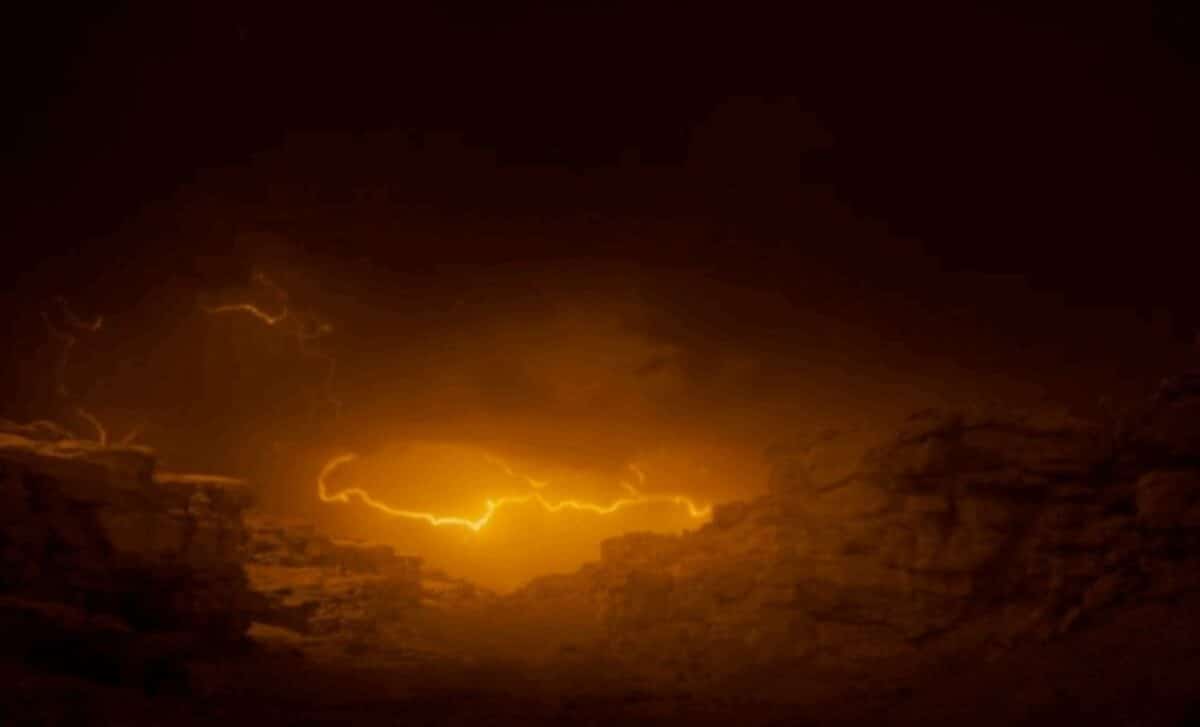
For decades, the crimson shroud of Mars has held countless secrets, compelling humanity to gaze upon its distant expanse with a mixture of wonder and scientific curiosity. Among the most enduring enigmas has been the question of whether its colossal, planet-engulfing dust storms, known for their violence and sheer scale, could generate electrical phenomena akin to lightning on Earth. Now, a groundbreaking discovery by a NASA orbiter has not only answered that question with a resounding 'yes' but has simultaneously rewritten our understanding of the Martian atmosphere and its potential for dynamic, complex processes.
The Long-Standing Martian Enigma
Mars is famous for its dust storms, events that can escalate from localized gusts to atmospheric behemoths capable of cloaking the entire planet in a dense, ochre haze for months. These storms are driven by extreme temperature differentials and powerful winds, lifting millions of tons of fine particulate matter high into the thin Martian atmosphere. Planetary scientists have long theorized that the sheer friction generated by billions of dust grains colliding within these monstrous vortices could, in principle, create sufficient static electricity to produce lightning. However, direct observation remained elusive, a tantalizing hypothesis without definitive proof.
The challenges in confirming this phenomenon were immense. The Martian atmosphere, though thin, can become optically opaque during these global dust events, making direct visual detection of ephemeral lightning flashes incredibly difficult. Furthermore, the specialized instrumentation required to detect the specific electromagnetic signatures of lightning discharges had not, until recently, been precisely tuned or positioned to make such a discovery.
A Glimpse into the Storm's Heart: The Breakthrough
The paradigm shift arrived thanks to a specialized sensor aboard a NASA orbiter, meticulously designed to penetrate the veils of the Martian atmosphere. During one of Mars's most recent and ferocious global dust storms, this sensor registered unmistakable evidence: distinct electromagnetic pulses characteristic of lightning discharges. This wasn't a fleeting anomaly but a clear, measurable signal, marking the first confirmed instance of lightning within the Martian atmosphere.
This discovery fundamentally alters our perception of Mars's atmospheric dynamics. It suggests that the electrical properties of the Martian atmosphere during these dust events are far more active and complex than previously understood. The implications extend beyond meteorology, hinting at previously unrecognized atmospheric chemistry and energy transfer mechanisms.
Scientific Revelations and Future Implications
The confirmation of Martian lightning opens a Pandora's Box of scientific inquiry. Firstly, it provides crucial data for refining atmospheric models of Mars, allowing scientists to better predict the behavior and impact of future dust storms. Understanding the electrical activity within these storms is vital not just for theoretical science but also for practical applications, particularly concerning future human missions to Mars. Astronauts and delicate electronic equipment could be vulnerable to electrical discharges or increased radiation fluxes associated with such phenomena.
Secondly, and perhaps more profoundly, this discovery reignites discussions about Martian habitability and the potential for prebiotic chemistry. On Earth, lightning plays a significant role in nitrogen fixation, a process essential for life, and can trigger complex chemical reactions in the atmosphere. Could Martian lightning have similarly influenced the planet's past chemistry, perhaps even contributing to the conditions necessary for the emergence of life, if it ever existed? While highly speculative, the presence of an energy source like lightning adds another layer to the complex puzzle of Mars's ancient environment.
Furthermore, studying Martian lightning offers a unique comparative planetology opportunity. How do these electrical discharges differ from those on Earth, Venus, or gas giants like Jupiter? The distinct atmospheric composition, pressure, and dust characteristics of Mars likely create a unique type of lightning, providing invaluable insights into fundamental physics of electrical discharge in varying planetary environments.
The Road Ahead: Unveiling More Martian Secrets
This pioneering observation is undoubtedly just the beginning. The scientific community will now be eager to deploy more sophisticated instruments capable of mapping these lightning events, measuring their intensity, and analyzing their spectral signatures. Future missions to Mars, both orbital and surface-based, may incorporate dedicated sensors to study these electrical phenomena in greater detail.
The confirmation of lightning on Mars is not merely an interesting footnote; it's a monumental stride in planetary science. It forces us to re-evaluate our long-held assumptions about the 'Red Planet' and underscores the fact that even seemingly barren worlds hold dynamic, surprising processes waiting to be uncovered. As NovaPress continues to report on these incredible findings, one thing is clear: Mars remains a planet of boundless discovery, and its electrified skies are now calling to us with a new, powerful voice.