Unveiling Earth's Hidden Giants: Continent-Sized 'Islands' Dwarf Everest, Reshaping Our Planetary Understanding
Deep beneath our feet, far beyond the reach of any drill or probe, scientists have made a discovery that is literally continent-sized in its implications. Two colossal regions, dubbed "islands," have been found lurking within Earth's mantle, each dwarfing landmasses on the surface and towering 100 times higher than Mount Everest. This revelation from Utrecht University is not just a fascinating geological footnote; it fundamentally challenges our models of planetary dynamics and the very heart of our world.
A Glimpse into the Earth's Unseen Depths
For centuries, humanity has strived to understand the intricate workings of our planet. While we have mapped the surface in exquisite detail and explored the oceans' abyssal plains, the vast majority of Earth's volume remains a mystery. The mantle, a layer of hot, viscous rock extending from about 30 kilometers to 2,900 kilometers below the crust, is where the engine of plate tectonics resides. It's a dynamic, churning realm of immense pressures and temperatures, yet direct observation is impossible. Our understanding has largely relied on seismic waves – echoes from earthquakes that travel through the planet, revealing clues about its internal structure.
The Discovery: Unprecedented Scale and Mystery
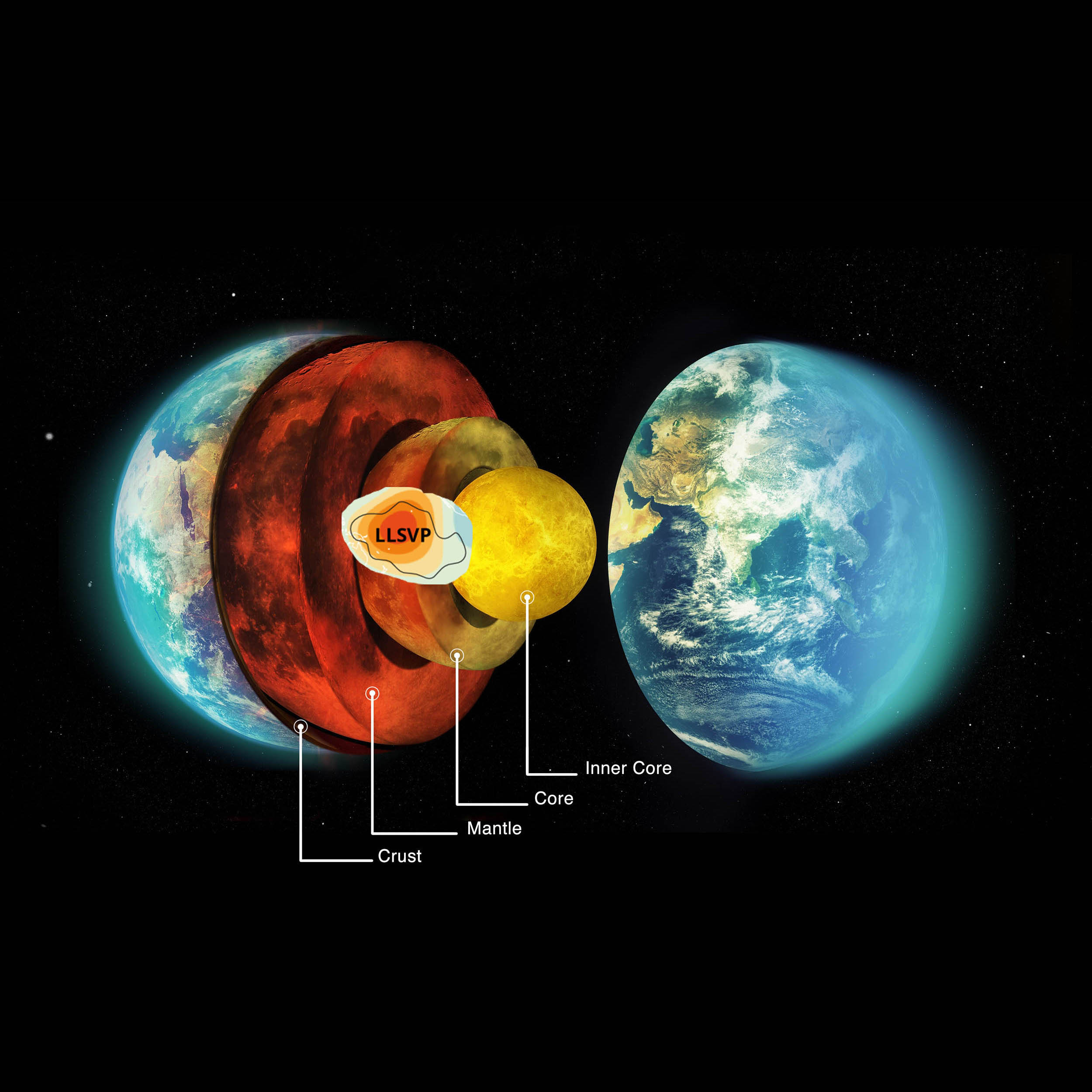
The new research, spearheaded by scientists at Utrecht University, utilized sophisticated seismic tomography techniques, akin to a CT scan of the Earth. By analyzing how seismic waves propagate, slow down, or speed up as they pass through the mantle, researchers were able to pinpoint two gargantuan anomalies. These "islands," formally known as Large Low Shear Velocity Provinces (LLSVPs), are not merely large; they are monumental. Each is comparable in area to an entire continent, and their vertical extent is truly mind-boggling – stretching upwards by thousands of kilometers, making them approximately 100 times taller than the world's highest peak, Mount Everest.
Located near the core-mantle boundary beneath Africa and the Pacific Ocean, these structures are distinct from the surrounding mantle material. While their exact composition remains a subject of ongoing research, evidence suggests they are denser and hotter than their surroundings. This implies they are likely piles of ancient, primordial material that has resisted mixing with the rest of the mantle for billions of years, or perhaps reservoirs of material that have descended from the surface over geological timescales.
Re-evaluating Earth's Internal Engine
The existence of these immense structures carries profound implications for our understanding of geodynamics:
- Mantle Convection: These "islands" act as massive barriers or anchors within the mantle, potentially influencing the global patterns of convection – the slow churning of the mantle that drives plate tectonics. Their presence could explain anomalies in tectonic plate movements and the distribution of geological features on the surface.
- Hotspots and Volcanism: Many scientists hypothesize that these LLSVPs are the source regions for mantle plumes, which are upwellings of hot rock that can punch through the crust, creating volcanic hotspots like Hawaii or the Yellowstone supervolcano. Understanding these 'islands' could unlock secrets about the mechanisms behind Earth's most explosive geological phenomena.
- Earth's Magnetic Field: The core-mantle boundary is a crucial region where heat transfer from the core influences the convection of liquid iron in the outer core, which in turn generates Earth's magnetic field. The colossal structures at this boundary could have a direct impact on the magnetic field's strength, stability, and reversals over geological time.
- Planetary Evolution: If these "islands" are indeed primordial, they could represent relics from the early stages of Earth's formation, offering an unprecedented window into the planet's infancy and the processes that shaped it into the habitable world we know today.
The Future of Earth Science
This discovery marks a new frontier in Earth sciences. It highlights the continued potential for groundbreaking revelations even about our own planet. Future research will undoubtedly focus on refining the composition and precise geometries of these "islands," using more advanced seismic imaging and computational modeling. Scientists will seek to understand their long-term evolution, their interaction with plate tectonics, and their ultimate influence on the surface world we inhabit.
The notion that there are continent-sized features hidden deep within Earth, yet to be fully understood, is a humbling reminder of the vast mysteries that still lie beneath our feet. These "islands" are not just geological curiosities; they are fundamental components of Earth's engine, holding clues to its past, present, and future.