Unveiling the Cosmic Mirage: How an Einstein Cross Exposed a Supernova Billions of Light-Years Away
In a universe brimming with unfathomable distances and transient cosmic spectacles, astronomers have achieved a groundbreaking feat: detecting a superluminous supernova (SLSN) from an astounding 10 billion light-years away. This isn't just an observation; it's a profound peek into the early universe, made possible by one of Albert Einstein's most elegant predictions – gravitational lensing, manifest here as a rare and captivating "Einstein Cross." The discovery of SN 2025wny redefines the limits of cosmic visibility and opens new avenues for understanding the cosmos's most extreme events.
The Unseen Universe and Einstein's Cosmic Magnifying Glass
Our universe is vast, and its expansion means that light from the most distant objects has traveled for billions of years to reach us. At 10 billion light-years, SN 2025wny existed when the universe was only a quarter of its current age. Normally, a supernova at such an extreme distance would be far too faint for even our most powerful telescopes to resolve. Its light would be stretched, diluted, and scattered across the cosmic expanse, rendering it effectively invisible.
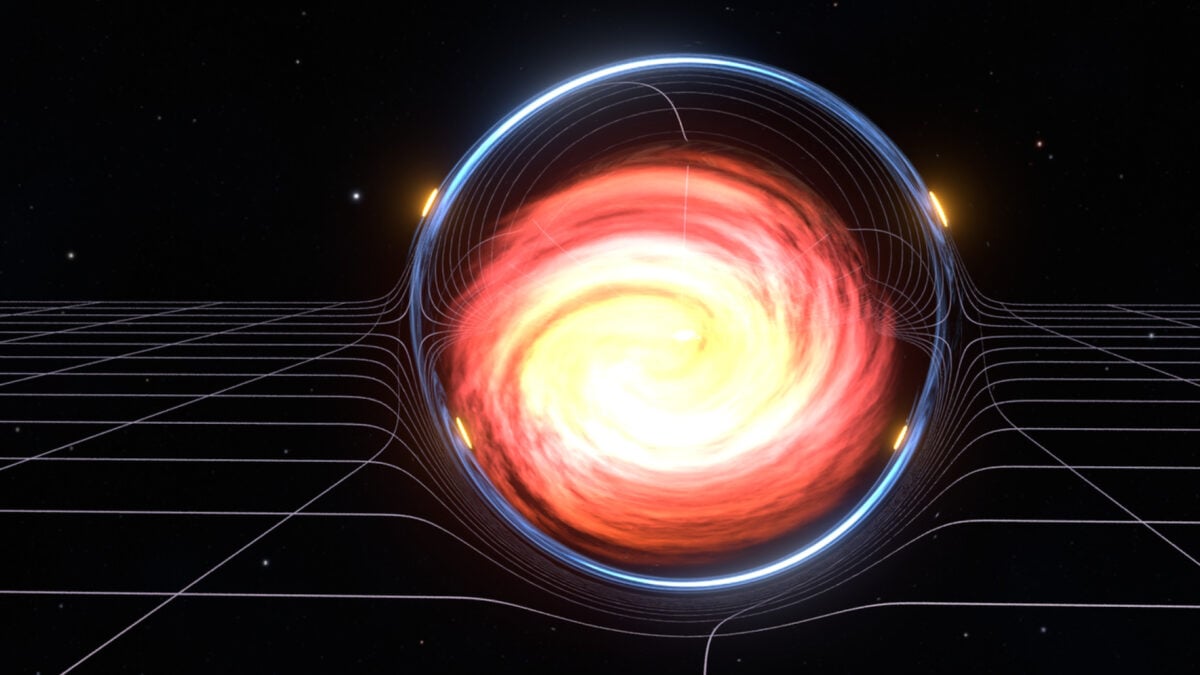
Enter gravitational lensing. Predicted by Einstein's theory of general relativity, this phenomenon occurs when a massive object – like a galaxy or a cluster of galaxies – sits directly between Earth and a more distant light source. The immense gravity of the foreground object warps the fabric of spacetime around it, bending the path of light rays that pass nearby. Instead of a single, direct path, light from the distant source is bent and refocused, acting like a cosmic magnifying glass.
An "Einstein Cross" is a particularly spectacular and rare manifestation of gravitational lensing. It occurs when the alignment between the observer, the lensing object, and the distant source is almost perfectly precise. The light from the background object is then split into four distinct images, arranged in a cross-like pattern around the central lensing object. Each image is a distorted but magnified view of the same single distant source, offering multiple pathways for its ancient light to reach our observatories.
SN 2025wny: A Lensed Superluminous Spectacle
The target of this incredible observation, SN 2025wny, isn't just any supernova. It's classified as a superluminous supernova (SLSN), a class of stellar explosions that are orders of magnitude brighter than typical supernovae. These cosmic titans are thought to originate from exceptionally massive stars, sometimes hundreds of times the mass of our Sun, which collapse and explode with an energy output that can briefly outshine entire galaxies. The sheer intrinsic brightness of SLSN makes them detectable across greater distances, but 10 billion light-years still pushes the boundaries of our capabilities.
In the case of SN 2025wny, its light was magnified by a foreground galaxy, perfectly positioned to create an Einstein Cross. This fortunate alignment didn't just make the supernova detectable; it amplified its light by an astonishing factor, bringing it within the observational reach of ground and space-based telescopes. The multiple images allowed astronomers to study the supernova's properties from different angles and, crucially, confirm its identity as a single, incredibly distant event.
Peering into the Cosmic Dawn: Implications for Science
This discovery holds profound implications across several fields of astrophysics:
- The Early Universe: Observing SN 2025wny means we are looking at a star that exploded when the universe was in its infancy. This offers a rare window into the conditions, star formation rates, and chemical enrichment processes of the early cosmos. SLSNe are particularly important because they are primary factories for heavy elements, which are then scattered into space to form new stars, planets, and even life itself.
- Refining Cosmological Models: The precise timing and geometry of gravitational lensing events, especially those producing multiple images, can be used to measure cosmic distances and the expansion rate of the universe (the Hubble Constant) with unprecedented accuracy. While this specific event is one data point, future discoveries of lensed supernovae will contribute to refining our cosmological parameters and testing models of dark energy and dark matter distribution.
- Unlocking Superluminous Supernovae Mysteries: Despite their extreme brightness, the exact progenitors and explosion mechanisms of SLSNe are still not fully understood. Observing them at such early cosmic epochs can provide crucial data points for theoretical models, helping to differentiate between various proposed scenarios, such as rapidly rotating magnetars or pair-instability supernovae.
- Gravitational Lensing as a Standard Tool: This success demonstrates the immense power of gravitational lensing as a natural cosmic telescope. As new, more sensitive observatories like the James Webb Space Telescope (JWST) and the upcoming Nancy Grace Roman Space Telescope come online, the strategic search for such lensed events will become an even more powerful tool, allowing us to routinely push the boundaries of observable space and time.
The Future of Lensed Transients
The detection of SN 2025wny through an Einstein Cross is more than just a lucky break; it’s a testament to the ingenuity of astronomers and the predictive power of fundamental physics. It heralds a new era where transient cosmic events – like supernovae, gamma-ray bursts, and perhaps even elusive primordial black hole mergers – can be observed at distances previously thought impossible.
Future all-sky surveys, coupled with advanced AI algorithms for identifying lensing candidates, will undoubtedly unearth more such "cosmic mirages." Each new discovery will serve as another beacon from the past, illuminating the universe's evolution and bringing us closer to answering fundamental questions about our cosmic origins. The universe, it seems, still has countless hidden fireworks waiting to be magnified into our view.